How to Invest in Private Equity


The number that reframes this whole question is not a private equity fund's headline return. It is roughly $100 — about the price of a single share of a listed private equity firm or an exchange-traded fund that holds them. For most of the last forty years, the honest answer to how to invest in private equity was that you did not, unless you were an institution or wealthy enough to write a seven-figure check. That barrier is falling. A 2025 executive order is prying open the door to 401(k)s, and a shelf of new retail vehicles now starts at the cost of one share.
Private equity means owning stakes in companies that are not listed on a public exchange, held through funds or a growing set of retail wrappers. What the falling entry price does not settle is whether any of it suits you: access is not the same as suitability, and most of this asset class is still illiquid. What follows is the actual map to investing in private equity as an individual in 2026 — who is eligible, what each route costs, how to buy, and the risks the brochures skip. It sits inside the site's broader investment coverage, which is the place to start if you are still deciding whether alternatives belong in your portfolio at all.
Why private equity is opening to everyday investors in 2026
Private equity — owning stakes in companies not publicly traded — is opening to everyday investors as policy and low minimums lower the bar. Search interest in how to invest in private equity has risen roughly 53% over the past year, and the reason is not only curiosity. The rules are changing, and with them what is actually available to you as a retail investor.
The sequence is specific and recent. On August 7, 2025, President Trump signed Executive Order 14330, "Democratizing Access to Alternative Assets for 401(k) Investors", directing regulators to widen access to private equity, private credit, and real estate inside workplace retirement plans. Five days later, on August 12, the Department of Labor rescinded a 2021 letter that had discouraged alternatives in those plans. On March 30, 2026, the DOL proposed a rule that would give plan fiduciaries a safe harbor for adding private equity to a 401(k) lineup. In parallel, the INVEST Act (H.R. 3383) passed the House in December 2025 and now sits before the Senate; it would broaden who counts as an accredited investor.
Here is the line worth holding onto. "The door is opening" is true and policy-backed. "You can move your whole retirement into private equity tomorrow" is not — whether you can hold private equity inside a 401(k) still depends on your specific plan's fiduciary and on rules that are proposed, not final. What the policy timeline tells you is direction. What it does not tell you is your date of access.
The vehicle side is expanding at the same time, and that is the more immediate driver. Interval funds, evergreen funds, and 40-Act tender-offer funds have proliferated across the large managers — Apollo, Ares, Blue Owl, KKR, and Blackstone (through vehicles such as BCRED and BXPE). That is the structural reason retail access is widening faster than any single policy headline suggests.
Are you eligible? Accredited investor and qualified purchaser rules
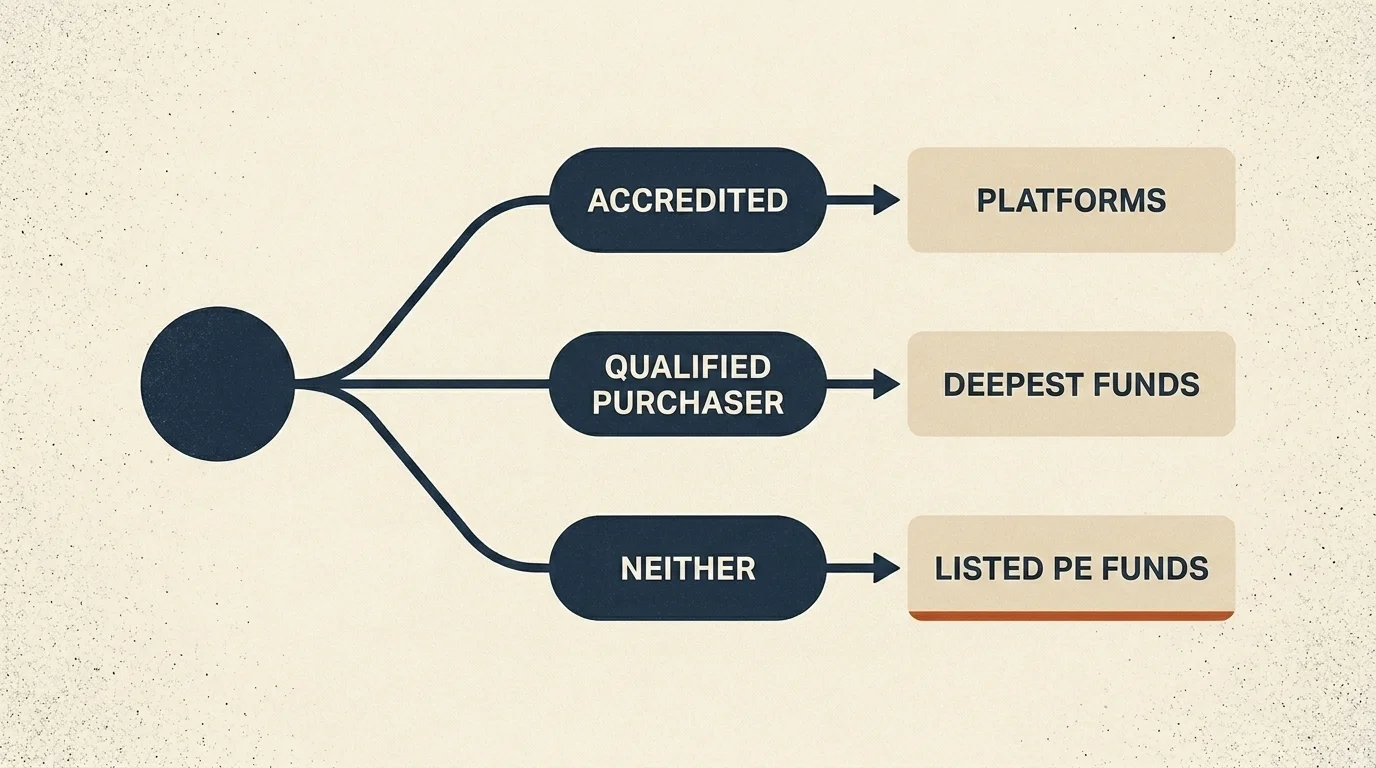
You do not need to be an accredited investor for every route into private equity — but you do for the traditional ones. That single distinction decides most of what is open to you, so run the definitions against your own numbers before you shop for a fund.
Accredited investor requirements (2026)
Under the SEC's definition, you are an accredited investor if your income exceeded $200,000 individually (or $300,000 jointly with a spouse) in each of the last two years, or your net worth exceeds $1 million, excluding the value of your primary residence. These thresholds are unchanged for 2026. Meeting either one opens the accredited-only routes: most feeder platforms and many limited-partner funds.
Qualified purchaser: the $5 million tier
A step above sits the qualified purchaser: an individual with at least $5 million in investable assets. This tier reaches the deepest, most restricted funds — the ones with the longest lockups and the largest commitments. Accredited status gets you into the room; qualified-purchaser status gets you into the funds that ask the most and, historically, gate the most.
Related Article: Red vs. Blue: The Battle of Colors in Investment Marketing
What if you're neither? Your open routes
If you meet neither bar, you are not shut out. Publicly traded private equity firm stocks, private equity ETFs, business development companies, and interval and evergreen funds are all open to you with no accreditation required. One line worth flagging: the INVEST Act, if the Senate passes it, would add education, experience, and licensure pathways to accredited status and index the dollar thresholds to inflation. Treat that as pending, not law — plan around the rules that exist today.
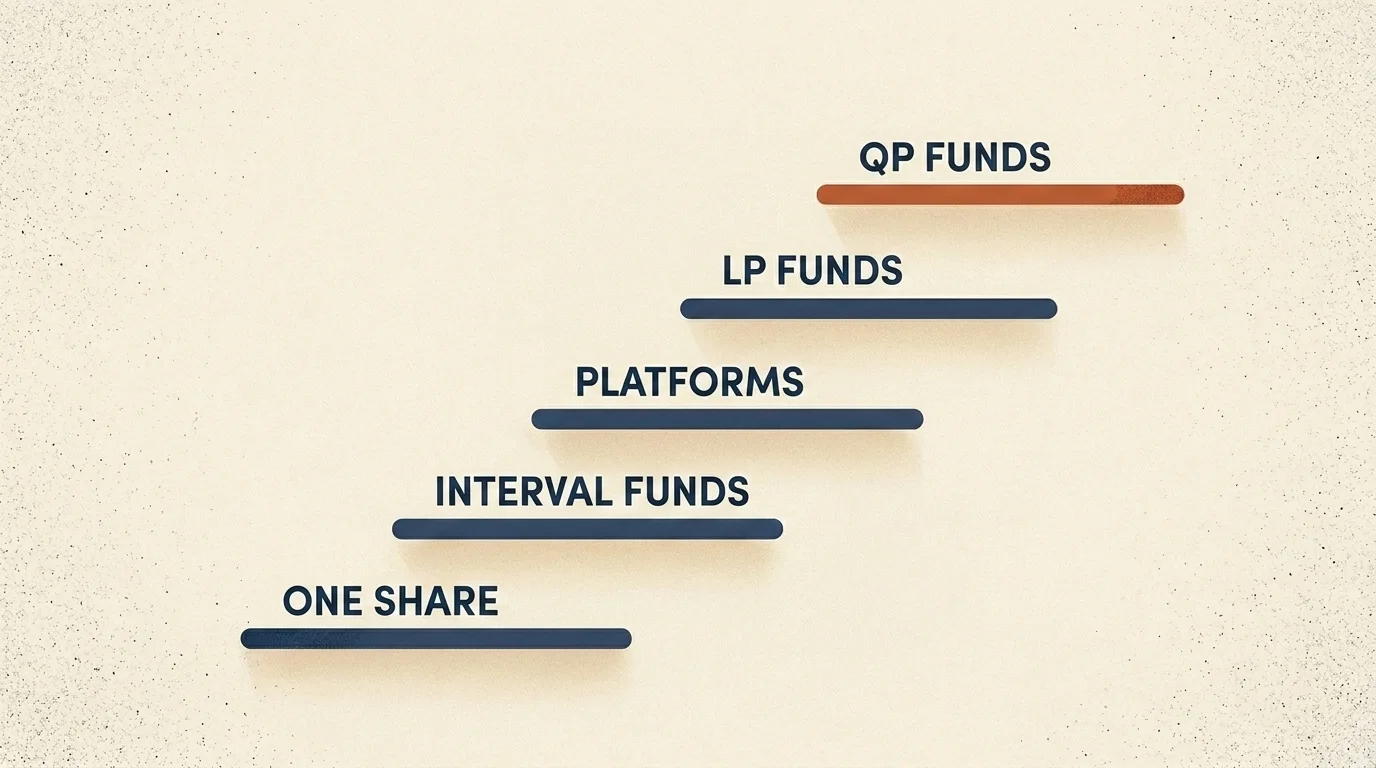
Private equity minimums — the $100-to-$5-million ladder
Private equity now starts at roughly the price of one share — about $100 — and climbs to $5 million for the deepest funds. There is no single private equity minimum investment, in other words: there is a ladder, and where you land on it is set almost entirely by your eligibility tier and by how much liquidity you are willing to surrender.
Minimums by vehicle (2026 table)
| Route / vehicle | Typical minimum | Accreditation |
|---|---|---|
| Listed PE firm stocks, PE ETFs, BDCs | ~$100 (one share) | None |
| Interval & evergreen funds | $2,500 – $25,000 | None |
| Feeder platforms (iCapital, Moonfare) | $50,000 – $100,000 | Accredited |
| Traditional LP fund commitments | $250,000 – $10M+ | Accredited / QP |
| Qualified-purchaser funds | $5,000,000 | Qualified purchaser |
Read the ladder as one relationship: the minimum tracks eligibility and liquidity together. The cheaper the entry, the more liquid the vehicle and, generally, the less "pure" the private-equity exposure it gives you.
Investing in private equity with little money
This is where the honest caveat matters most. A $100 entry buys you exposure to private-equity firms or a fund wrapper around them — not a seat in a specific buyout deal. That is not a criticism of the low-minimum route; it is a description of what your money actually holds. If your budget is small, you can absolutely start, but be clear-eyed that "invested in private equity" at the bottom of the ladder means something different from what it means at the top.
The lowest-barrier route — private equity ETFs, PE stocks, and BDCs
The fastest and cheapest way in is a standard brokerage account and a private equity ETF, a listed PE firm's stock, or a business development company. No accreditation, no platform onboarding, and you can buy a single share. These are listed proxies for private-equity economics, which is exactly their strength and their limit — and for now, this tier is what private equity for retail investors mostly means in practice.
Publicly traded private equity stocks (BX, KKR, APO)
The large private-equity managers are themselves public companies. Buying Blackstone (BX), KKR, or Apollo (APO) makes you a shareholder in the firm that runs the funds — you earn from its management fees, carried interest, and balance sheet. You are betting on the manager as a business, not on any one of its portfolio deals.
Private equity ETFs: a short list and how to read one
A private equity ETF bundles those listed managers, and sometimes BDCs, into a single ticker. Representative examples include the Invesco Global Listed Private Equity ETF (PSP) and the ProShares Global Listed Private Equity ETF (PEX) — named to illustrate the category, not as recommendations. Working from any private equity ETF list, check three things before you buy: what each fund actually holds (listed PE firms, BDCs, or both), its expense ratio, and how concentrated it is in a handful of names. There is no single best private equity ETF, only the one whose holdings you can explain in a sentence — a better filter than any ranking you will find.
BDCs: listed access to private-company lending
A business development company is a listed vehicle that lends to, or invests in, small and mid-sized private firms. Ares Capital (ARCC) is one such vehicle — named, like PSP and PEX above, to illustrate the category, not as a recommendation. BDCs sit adjacent to private equity, and their headline yields often look generous next to ordinary stocks. Treat a high quoted yield as a question — what is funding the payout? — rather than as a feature. They trade like stocks, which means you get daily liquidity and, with it, daily price swings the underlying private loans do not have.
The trade-off across all three sub-routes is the same, and it is the bright line of this entire topic: these are liquid, cheap, and open to any retail investor, but the exposure is to private-equity managers' listed stock and the public market's mood — not to the illiquid deals inside their funds. That is a real distinction, not a technicality.
Higher-access routes — interval funds, platforms, and traditional PE funds
Above the listed route sits a tier of vehicles that hold actual private assets, ranked here by rising barrier. This is also where the newer, low-minimum structures live — the ones most competitor guides skip.
Interval and evergreen funds (no accreditation)
Interval and evergreen funds are the genuine middle ground. They are SEC-registered closed-end funds that offer quarterly redemption windows for a limited slice of shares — typically 5% to 25% — with minimums of roughly $2,500 to $25,000 and no accreditation required. That makes them more liquid than a traditional fund and less liquid than a stock: you can get out, but only on the fund's schedule and only up to its cap. Alongside them sit 40-Act tender-offer funds and private equity mutual funds, the "simplified access" wrappers large managers like J.P. Morgan have leaned on to bring private assets to retail accounts.
Related Article: Sustainable Investing: Aligning Values with Financial Goals
Feeder platforms: Moonfare, iCapital, Yieldstreet
Feeder platforms are accredited-investor gateways to brand-name funds you otherwise could not reach individually. Moonfare, iCapital, and Yieldstreet pool investors to meet a large fund's minimum, then charge you their own layer of fees for the access — expect entry points around $50,000 to $100,000. Adjacent to them are equity crowdfunding platforms such as Fundrise and CrowdStreet, which open private-market deals to smaller checks.
Traditional LP funds and fund-of-funds
The classic path is committing capital as a limited partner in a private equity fund or a fund-of-funds, starting around $250,000 and running far higher. This is the deepest exposure and the highest barrier: the longest lockups, the largest commitments, and the capital-call mechanics covered below. A fund-of-funds spreads your commitment across several underlying funds for diversification, at the cost of a second layer of fees.
How to invest in private equity, step by step
Once you know your tier and your budget, the execution path is short. The two things beginners underestimate are both at the end — capital calls, and what "invested" actually means on a committed-capital route.
Step 1–3: eligibility, route, account
- Confirm your eligibility tier. Run the accredited and qualified-purchaser definitions against your own income and net worth.
- Pick a route by budget using the minimums ladder — the lowest-barrier route that fits your horizon, not the most prestigious one you can technically reach.
- Open the right account. For ETFs, PE stocks, and BDCs, a standard brokerage account is all you need. For funds and platforms, expect onboarding plus accreditation verification before you can commit.
Related Article: Impact of Inflation on Investment Strategies
Step 4–6: size, fund, and hold
- Size the allocation sensibly — a modest sleeve of a diversified portfolio, not its core.
- Fund it, and understand capital calls. On committed-capital routes you do not hand over the full amount at once; you pledge it, and the fund draws it down over several years as it finds deals. You must keep that cash available on the fund's timeline.
- Plan to hold through the lockup and read every fee line before you sign — on an LP route, "invested" means "committed for years," not "able to sell next week."
The risks, fees, and lockups the brochures skip
This is the section the promotional pages leave thin, and it is the one that decides whether private equity is a reasonable idea for you. None of what follows is a reason to avoid the asset class. It is the honest limit of what the returns brochure is telling you.
Illiquidity and lockups
The core cost is time. Traditional private equity locks your money up for five to ten years or more, and there is often no early exit at any price. Interval and evergreen funds soften this with their redemption windows, but only within a cap. Before you commit, assume the money is genuinely stuck for the fund's full life, because on the traditional route it is.
The J-curve and capital calls
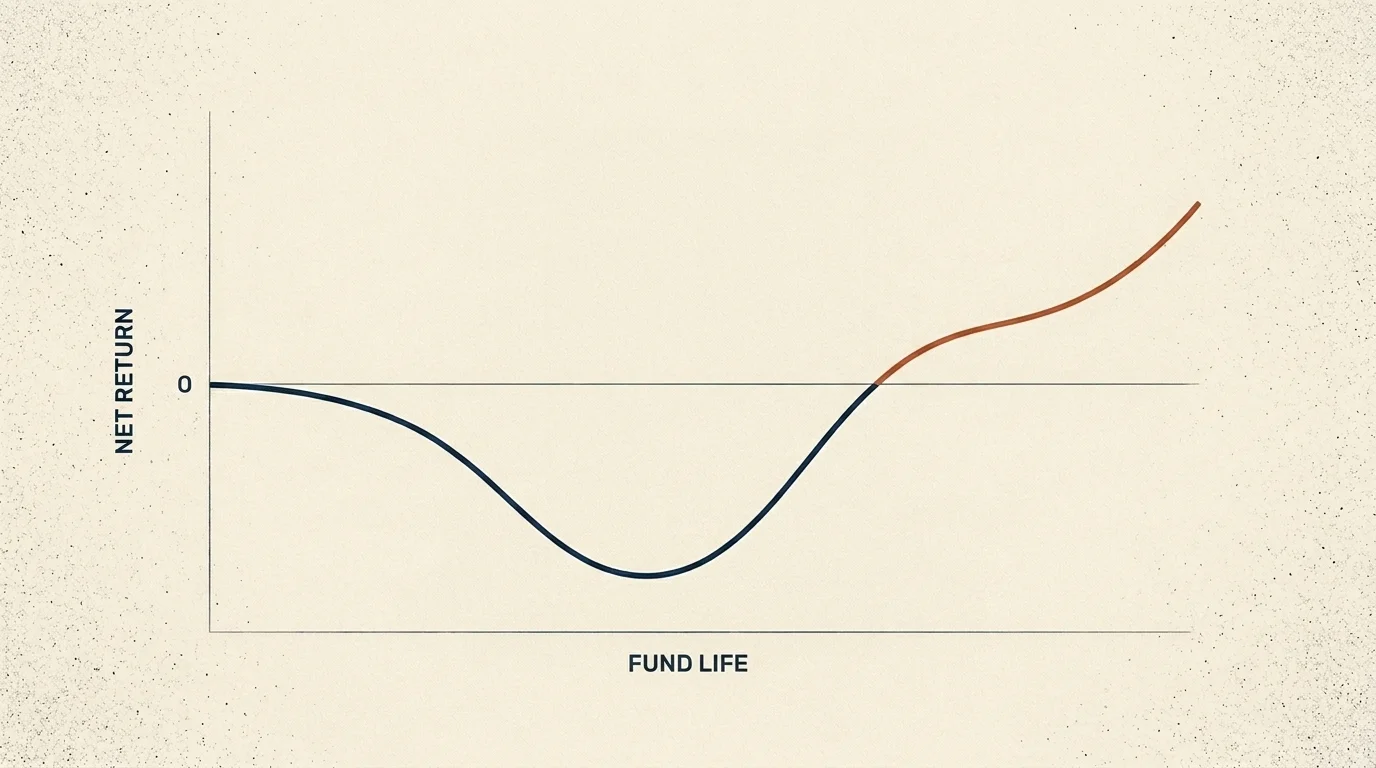
Returns in a private equity fund typically follow a J-curve: they dip before they rise. Fees and early costs hit first, while the value of the underlying companies takes years to be realized through exits. Meanwhile, capital calls arrive on the fund's schedule, not yours — you can be asked to send committed cash during a period when the reported return is still negative. Both facts are normal. Both catch first-time investors off guard.
Related Article: The Power of Dividend Investing: Building Passive Income Streams
Fees: what "2 and 20" really costs
The classic fee structure is "2 and 20": a 2% annual management fee plus 20% of the profits, known as carried interest. Over a decade, the 2% compounds against your entire commitment whether the fund performs or not, and the 20% carry takes a fifth of the upside. The listed wrappers — ETFs and interval funds — replace this with their own expense ratios, which are lower but still real. The question is never whether the fees are high; they are. The question is whether the after-fee return justifies the illiquidity you accepted to earn it.
Is private equity right for you?
Put the pieces together into one self-check. Private equity makes sense only if four things are true at once: you clear an eligibility tier, you can meet a minimum without straining, you can tolerate five to ten years of illiquidity, and your portfolio is large enough that a modest private-equity sleeve will not wreck your access to cash when you need it.
For you if: you have spare, long-horizon capital, you have read the fee and lockup terms with your eyes open, and private equity would be a diversifier rather than a core holding. Not for you if: you might need the money inside a decade, the minimum would concentrate your savings, or the appeal is mostly that the asset class used to be exclusive. The one development that could genuinely change this calculus is the 401(k) rules finalizing, or a lower-cost, more-liquid wrapper maturing enough to trust — worth watching, not yet worth waiting for. If you are weighing it, read this alongside the site's broader investment strategies coverage, and take any allocation decision to a licensed advisor who knows your full picture.
The bottom line
The barrier to private equity fell; the discipline it demands did not. In one breath: figure out your eligibility tier, choose the lowest-barrier route that fits your time horizon, and read every fee and lockup term before you commit a dollar. Access widening — through ETFs, interval funds, and the slowly opening 401(k) door — is not the same as this being right for everyone, and knowing how to invest in private equity is not the same as knowing whether you should. This is education, not individual financial advice; for your specific circumstances, consult a licensed advisor. When you are ready to place it in a wider plan, the site's investment coverage is where that context lives.
Frequently Asked Questions
Yes. Publicly traded PE stocks, PE ETFs and BDCs, and interval or evergreen funds (minimums from about $100 to $25,000) all accept retail investors and require no accreditation.
From the price of one share for a PE ETF or BDC, $2,500 to $25,000 for interval funds, $50,000 to $100,000 on feeder platforms, and $250,000 or more for traditional LP funds.
Income over $200,000 individually (or $300,000 jointly) in each of the last two years, or net worth over $1 million excluding your primary residence. $5 million in investable assets makes you a qualified purchaser.
A 2025 executive order (EO 14330) and a 2026 DOL proposed rule are opening 401(k) plans to private equity, but availability depends on your plan's fiduciary and the rollout, which is not yet final.
Illiquidity with five-to-ten-year lockups, capital calls on the fund's schedule, the J-curve, and high '2 and 20' fees — a 2% management fee plus 20% of profits.