Crowdsourcing


More than 60% of organizations now run some form of crowdsourcing, and a share of them report cutting operational costs by as much as 40% on the work they hand to the crowd (Cognitive Market Research). Those are the two numbers worth holding before the marketing language arrives, because crowdsourcing is not a movement — it is a resource-allocation decision.
Here is the definition to keep: crowdsourcing is the practice of sourcing ideas, skills, labor, or capital from a large, undefined group of people — the crowd — through an open call, rather than assigning the work to designated employees or hired agents. The contributors self-select, and the organization keeps or aggregates the best of what comes back.
The honest question is not whether crowdsourcing is fashionable. It is whether the crowd produces a better return on the resource you are actually short of — ideas, labor, or money. This guide covers how it works, the work-versus-capital decision, the main types, real examples, the platforms, and the pros and cons.
How does crowdsourcing work?
Crowdsourcing works through an open call: an organization posts a task or a problem, a large distributed crowd contributes, and the best contributions are selected and rewarded.
Underneath that sentence is a repeatable loop. You define the task, broadcast it to an undefined crowd rather than a named team, collect the contributions, filter and score them, and then reward or aggregate the ones that clear your bar. The mechanics do not change much whether the crowd is labeling images, voting on a logo, or pledging money — only the unit being sourced changes.
The term is not new. Jeff Howe coined it in a 2006 Wired article, describing the act of taking a job traditionally performed by a designated agent — usually an employee — and outsourcing it to an undefined, generally large group of people in the form of an open call. Two decades on, the practice has moved from novelty to infrastructure: more than 60% of organizations now use crowdsourcing to enhance productivity, roughly 64% use dedicated crowdsourcing software to speed up innovation cycles, and adopters report operational-cost declines of up to 40% on work they route through the crowd (Cognitive Market Research — figures that vary by scope). Increasingly, AI does the first pass: around 46% of platform vendors now use AI-driven evaluation to triage and score crowd input before a human reviews it.
Strip away the vocabulary and crowdsourcing does one financial thing: it converts a fixed labor or idea cost into a variable, market-priced one. You stop paying a salaried team to generate options and start paying only for the options you accept. That is the trade worth naming plainly, because it is also where the risks live.
Should you crowdsource the work or crowdfund the capital?
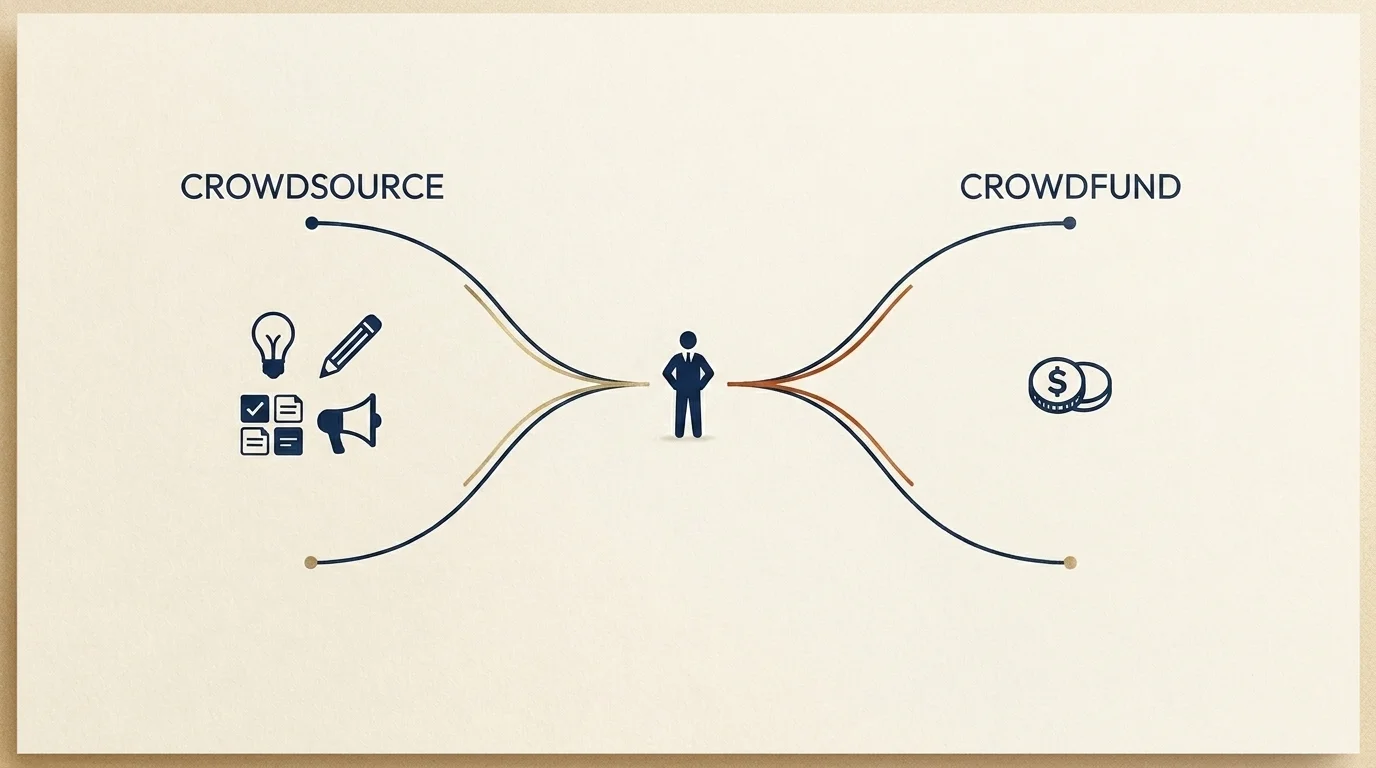
Crowdsource the work when you are short of ideas, validation, or labor; crowdfund the capital when you are short of money. Most startups need both — usually in that order.
This is the distinction that organizes everything else. Crowdsourcing sources ideas, skills, or labor. Crowdfunding — its capital-raising cousin — sources money. One builds the product; the other funds it. Founders blur the two because both start with "crowd," but they solve different scarcities, and the useful first question is diagnostic, not aspirational: what are you actually short of?
A decision table — what are you short of?
| What you're short of | The lever | What the crowd gives you |
|---|---|---|
| Ideas or validation | Idea sourcing and crowd voting | Direction and proof before you spend |
| Design or creative | Creative crowdsourcing | Options at the price of the ones you keep |
| Labor or data | Microtasking (crowdsourcing work) | Scale on repetitive tasks, priced per unit |
| Reach or marketing | Crowdsourced marketing | Distribution and participation, not just impressions |
| Money | Crowdfunding | Capital — and, on reward platforms, pre-validated demand |
Read the table as a resource-allocation grid, not a menu. Each row is cheap on the resource named in the left column and expensive on the one you still have to supply — usually judgment. This is where the topic connects to a broader investment strategy: every row is a decision about which scarce input you are buying and which one you are keeping in-house.
How the two combine in a startup's resourcing strategy
The efficient order is sequential: crowdsource validation first, crowdfund capital second. Idea sourcing and crowd voting are cheap and fast; they tell you whether anyone wants the thing before you ask anyone to pay for it. Then, once you have proof, you crowdfund — and the proof is not a nicety. Reward-based crowdfunding campaigns succeed at roughly 39.6%, well above the 22–24% average across all crowdfunding, and campaigns that arrive with clear storytelling and visuals do materially better (ElectroIQ, 2025). Validation-first is not a philosophy; it is what raises your odds when the capital ask finally comes.
Two disciplines keep this honest. Name the assumption: the crowd is only cheaper if you can filter its output well. And name the single variable that breaks it: the moment your quality-control cost exceeds the labor or capital the crowd saved you, crowdsourcing has stopped paying, and no adoption statistic changes that arithmetic.
Related Article: Red vs. Blue: The Battle of Colors in Investment Marketing
The main types of crowdsourcing
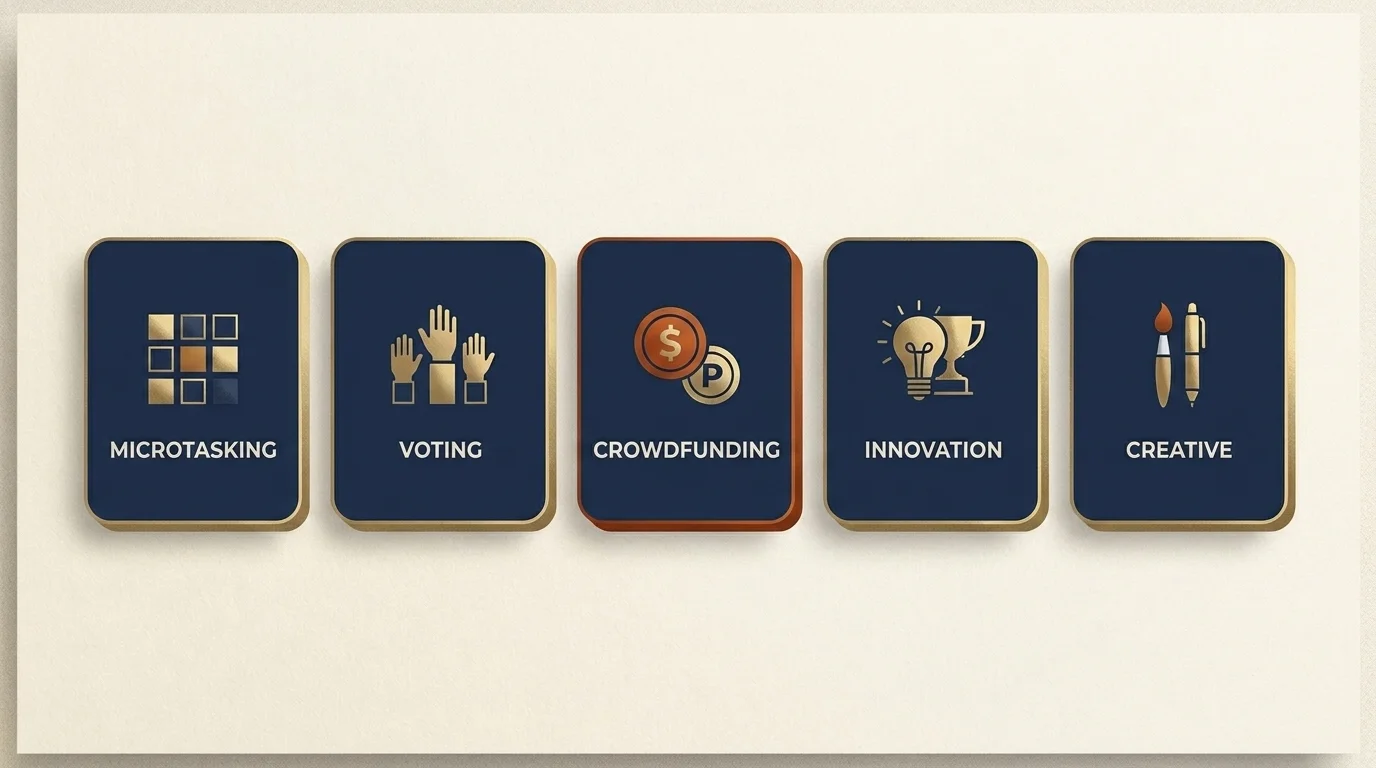
The five main types of crowdsourcing are microtasking, crowd wisdom or voting, crowdfunding, open innovation, and creative crowdsourcing. Each sources a different resource, and each maps back to a row in the decision table above.
Microtasking
Large jobs split into small, paid units — image labeling, content moderation, data cleanup — distributed across many workers. This is crowdsourcing work in its most literal form. Best for repetitive, decomposable tasks at scale; watch out for quality drift when the per-task price is set too low to attract careful work.
Crowd wisdom and voting
Aggregating many independent judgments — ratings, rankings, votes — to surface a better answer than any single expert would give. Best for prioritization and prediction where the crowd is genuinely diverse; watch out for herding, where early votes bias the later ones.
Crowdfunding
Sourcing capital rather than labor: many people contribute small amounts toward a goal. It is the funding member of the family and the bridge to the investment lane, covered in depth below. Best for pre-validated products with a story; watch out for treating pledges as guaranteed revenue.
Open innovation
Challenges and prize competitions that invite outside solutions to a defined problem — the model behind R&D contests and bug bounties. Best for hard, well-specified problems where you can recognize a good answer when you see it; watch out for vague briefs that draw noise instead of solutions.
Creative and content crowdsourcing
Design, copy, video, and other media produced by the crowd, often through contests — the overlap with crowdsourcing marketing. Best for volume and variety of creative options; watch out for intellectual-property terms that are not settled before submissions arrive.
Real-world crowdsourcing examples — with the outcomes
Wikipedia, Waze, Threadless, LEGO Ideas, and Foldit are classic crowdsourcing examples — each sources content, data, or product ideas from an open crowd rather than a payroll. Grouping them by what they crowdsource shows the framework in practice.
Data and knowledge. Wikipedia is crowd-authored reference at a scale no editorial staff could fund; Waze turns millions of drivers into a live traffic-data network, where the product improves precisely because the crowd is the sensor. The outcome in both cases is an asset whose marginal cost of content is near zero — the crowd is the supply chain.
Ideas and design. Threadless built an apparel business on crowd-voted designs, printing what the community had already said it wanted — validation and production folded into one step. LEGO Ideas takes fan-submitted concepts, puts them to a public vote, and turns the winners into commercial sets, giving the company pre-tested products and contributors a stake in the outcome. Doritos ran its "Crash the Super Bowl" contest for roughly a decade, sourcing some of its most-watched ads from customers instead of an agency.
Hard problems. Foldit turned protein folding into a game and let players solve structures that had resisted researchers — open innovation producing results a closed lab had not.
Capital. Kickstarter is the funding member of the set: cumulatively, more than 651,000 projects have launched on it with over $8.53 billion pledged (Statista, via ElectroIQ). That scale is the proof that strangers will fund a credible plan — but pledged is not the same as delivered, which is the discipline the funding section returns to.
Where a hard number is not public, the honest move is to describe the outcome — validation, near-zero content cost, community ownership — rather than invent a figure. The pattern across all of them is identical: the crowd supplied the scarce input, and the organization supplied the judgment to filter it.
Crowdsourcing platforms compared
Crowdsourcing platforms fall into a few categories — microtask marketplaces, research panels, innovation-challenge platforms, design marketplaces, and crowdfunding sites. The right one is dictated by the resource you identified earlier, not by the biggest brand name.
Platform comparison
| Platform | What it's for | Crowd type | Best-fit use case |
|---|---|---|---|
| Amazon Mechanical Turk | Microtasking | On-demand task workers | Data labeling, moderation, survey work at scale |
| Prolific | Research and survey panels | Vetted study participants | Higher-quality research data than open marketplaces |
| HeroX | Innovation challenges | Solvers and specialists | Prize competitions for defined problems |
| Wazoku | Enterprise idea management | Internal and external innovators | Structured open innovation inside larger organizations |
| 99designs | Creative crowdsourcing | Freelance designers | Logos, branding, and design by contest |
| Kickstarter | Crowdfunding | Backers and early adopters | Reward-based capital for a launch-ready product |
The rule for choosing is mechanical: match the platform's crowd to the scarcity you named. Labor points to MTurk or Prolific; innovation to HeroX or Wazoku; design to 99designs; capital to Kickstarter. A platform that owns the wrong crowd will underperform regardless of its marketing.
The software market underneath these tools is growing, but treat any single figure with suspicion — estimates vary widely by what each firm counts as "crowdsourcing." One projection puts the crowdsourcing-software market near USD 1.5 billion in 2026; another puts the broader platform market several times higher. The direction is up; the precise size is not settled (Market Growth Reports; Verified Market Reports). For a decision-maker, the trend matters and the headline dollar figure does not.
Crowdsourcing vs crowdfunding — labor vs capital
Crowdsourcing sources ideas, skills, or labor from a crowd; crowdfunding sources money. Crowdsourcing can run indefinitely; crowdfunding is usually a one-time, time-boxed goal.
The cleanest statement of the difference comes from the plainest sources. As Indeed's career guide puts it, crowdfunding is the process of sourcing money from a group of people, while crowdsourcing sources information, skills, or end products. Startups.com adds the timing distinction: crowdfunding is normally a one-time event with a set goal and deadline, whereas a crowdsourcing initiative can continue as long as the organization wants input. Labor is a program; capital is a campaign.
Related Article: Sustainable Investing: Aligning Values with Financial Goals
When to use which
Crowdsource when the constraint is ideas, validation, or labor — the input that builds the thing. Crowdfund when the constraint is money and you already have proof the thing is wanted. In a startup's sequence, the first usually precedes the second, which is why validation-first resourcing is the efficient path.
The capital side deserves sober numbers. Only about 22–24% of crowdfunding campaigns succeed overall; reward-based campaigns lead at roughly 39.6%, while equity crowdfunding sits near 20%, and campaigns with clear storytelling and visuals are about 60% more likely to hit their goal (ElectroIQ, 2025). Read these as directional estimates, not guarantees — the base rate for raising money from strangers is failure more often than success.
Raising or investing capital this way is a real financial decision with real downside. In the US, securities-based crowdfunding is governed by the SEC's Regulation Crowdfunding, which routes offerings through registered intermediaries and caps both what a company can raise and what an individual can invest in a 12-month period. None of this is individual financial advice; for your own circumstances, consult a licensed advisor before you back a campaign or launch one.
Pros, cons, and managing the risks
Crowdsourcing can cut costs and speed innovation, but it introduces quality-control, intellectual-property, and fair-pay risks that have to be actively managed. The benefits are real; so is the overhead.
Benefits
- Cost efficiency — adopters report operational-cost declines of up to 40% on crowdsourced work (Cognitive Market Research), because you pay for accepted output rather than salaried capacity.
- Speed and scale — an open call reaches far more contributors, faster, than any hiring process.
- Diverse skills — the crowd brings perspectives and specialties no single team holds.
- Built-in validation and community — when the crowd helps build the product, it also holds a stake in the product, which is validation and marketing folded into the work.
Drawbacks and how to mitigate them
- Quality control. Open contribution means uneven contribution. Mitigate with scoring, redundancy (multiple workers per task), and the AI-driven evaluation now used by roughly 46% of platform vendors to triage input before humans review it (Cognitive Market Research).
- Intellectual-property ownership. Ambiguous rights are the most common expensive mistake. Settle ownership and licensing in the terms before the first submission, not after a winner emerges.
- Fair pay and labor ethics. Microtask rates set too low produce both bad work and a genuine ethical problem. Publish transparent rates and treat the crowd as labor, because it is.
- Unverified information. Crowd data can be wrong or gamed. Build verification into the pipeline rather than trusting volume as a proxy for truth.
The mitigation is the point. The flag without the fix is where most reference pages stop, and it is useless to a decision-maker.
Here is what changes the calculus, and it is a single number, not a mood: crowdsourcing stops paying the moment the cost of managing the crowd — filtering, verifying, protecting IP, paying fairly — exceeds the labor or capital it saves. Watch that line. Everything else is commentary.
Related Article: Impact of Inflation on Investment Strategies
The one question worth keeping
Strip out the enthusiasm and crowdsourcing is one question asked well: what are you actually short of — ideas, labor, or capital — and does the crowd return more on that specific scarcity than your own team would? Crowdsource the work when the answer is ideas or labor; crowdfund the capital when the answer is money; and when it is both, crowdsource the validation first so the funding ask arrives with proof. Use the decision table above as the takeaway tool, and browse the rest of our investment coverage for the funding side of the picture. As always, none of this is individual financial advice — for your own situation, consult a licensed advisor.
Frequently Asked Questions
Wikipedia, Waze, and LEGO Ideas are classic examples: each sources content, data, or product ideas from a large open crowd instead of paid staff.
Crowdsourcing sources ideas, skills, or labor from a crowd; crowdfunding sources money. One builds the product, the other funds it.
It can cut project costs (organizations report up to ~40% operational savings) and speed innovation, but it carries quality-control, IP, and fair-pay risks that need managing.
Using the crowd to validate ideas, source product designs, complete microwork, and raise capital (via crowdfunding) as a low-cost resourcing strategy for a startup.