
Budget Challenge


I will be honest about my bias before we start: I am a financial planner, and I am constitutionally suspicious of the phrase "budget challenge," because most content wearing that label is gimmick packaging dressed up as a plan. But a budget challenge is worth writing about anyway, because underneath the good ones sits a mechanic that is genuinely load-bearing — a fixed rule that moves a set, and usually rising, amount out of your spending before you can talk yourself out of it. That is automation doing the work your willpower keeps promising to do.
First, a disambiguation, because the search term is crowded. If you landed here hunting the trademarked Budget Challenge® school program, its login, or its quiz answers — or the California and Federal budget simulators where you balance a government deficit — this is not that. This is a consumer guide to the money-saving kind you run at home: ten challenges, what each one actually saves in round numbers, a table to pick one, and, because I am a CFP, where the money should go once you finish.
What Counts as a Budget Challenge — and What Doesn't
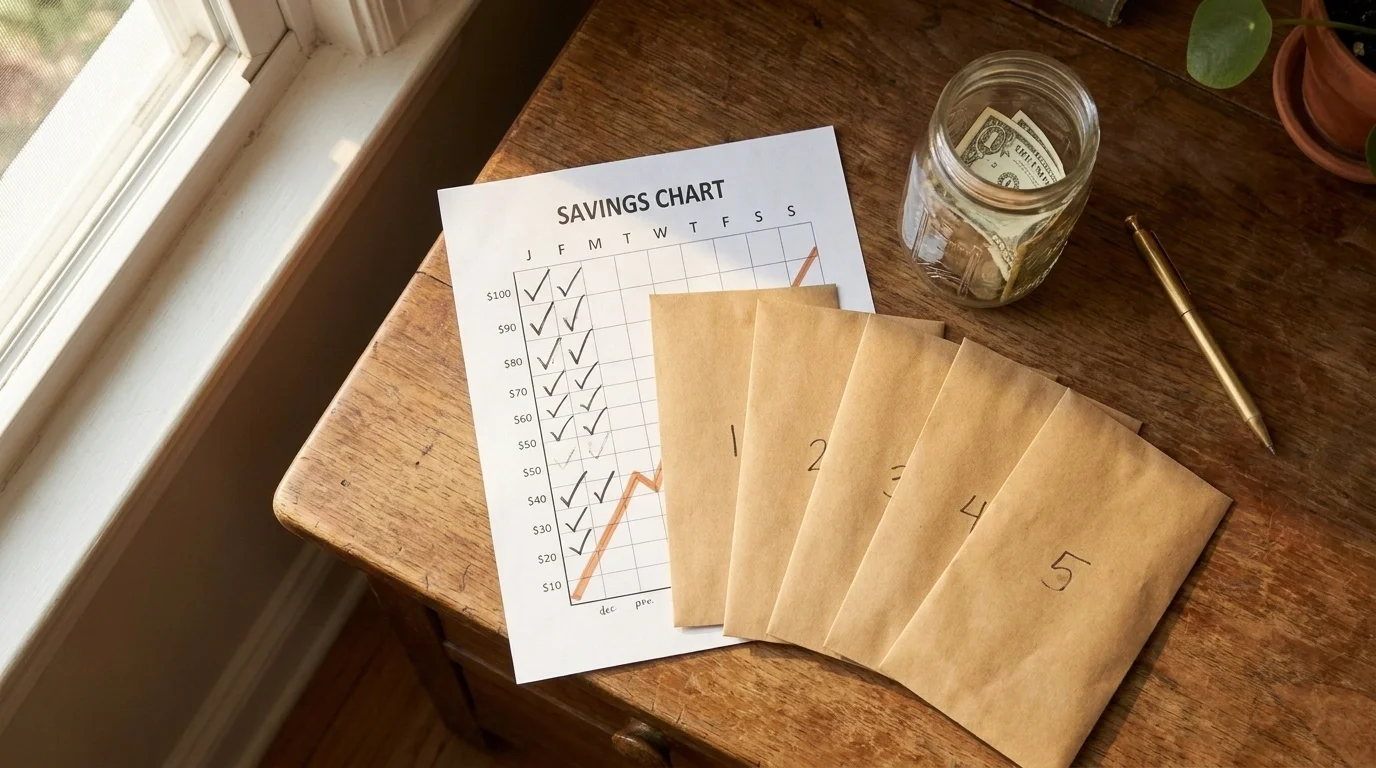
A budget challenge is a gamified, time-boxed rule that moves a set or rising amount into savings — distinct from the trademarked Budget Challenge® program and the government budget simulators. Strip away the printables and the color-coded trackers and every version shares the same three parts: a fixed rule, a deadline, and automation that takes the weekly decision out of your hands. That is the whole engine.
Here is the framing I would offer a client. A challenge is a behavior-change scaffold, not a wealth strategy, and it is useful precisely because it is small and finite. You are not funding a retirement in twelve weeks; you are proving to yourself that money can leave your checking account on a schedule and you will survive it. Treat it as one tool in a broader personal finance routine, not the routine itself.
Not the Budget Challenge® Program or the Government Simulators
Much of the search traffic for this term is not looking for a savings habit at all. It is students and teachers hunting the Budget Challenge® classroom program, or civics-minded readers looking for the California and Federal Budget Challenge simulators, where you balance a government deficit rather than your own. Useful tools — just a different topic. This guide is the at-home savings kind, and nothing here requires a login.
The 10 Challenges Side by Side: Difficulty, Duration, and What You'll Save
Here is the part no competitor bothers to build. Experian, Fidelity, and the big printable sites all publish the same flat numbered list — ten or eleven challenges, one after another, with no way to compare them at a glance. So before the individual walkthroughs, one table. Match a row to a real goal and a real temperament, then read only the sections you need.
| Challenge | Difficulty | Duration | ~Total saved | Best for |
|---|---|---|---|---|
| 100-envelope | Advanced | ~100 days | $5,050 | A big goal on a short deadline |
| 52-week | Beginner | 1 year | $1,378 | A steady paycheck and a full year |
| 26-week | Intermediate | 6 months | $1,053 | Half the calendar, steeper deposits |
| No-spend | Intermediate | 30 days | $300–$750 | Resetting spending, not just saving |
| Penny | Beginner | 1 year | $667.95 | An almost-invisible daily habit |
| $1-a-day | Beginner | 1 year | $365 | An absolute first-timer |
| $5-bill | Beginner | 1 year | ~$520 | People who still carry cash |
| Round-up | Beginner | Ongoing | Variable | Irregular or unpredictable income |
| $1,000 in a month | Intermediate | 1 month | $1,000 | A fixed target with a hard date |
| 50/30/20 pairing | — | Ongoing | Framework, not a total | The container the others live in |
How to read it: match the duration and total to a goal you can name, then match the difficulty to your temperament. The highest number in that column is not the best challenge — it is the best only if you are still doing it in week three. A $5,050 plan you quit in April saves less than a $365 plan you actually finish.
How to Choose the Right One for Your Cash Flow
The single most useful filter is how your money arrives. If your income is irregular — commissions, freelance, tips — pick a percentage or round-up rule, so a lean month scales the deposit down instead of breaking the streak. If you draw a steady paycheck, the schedule-based challenges fit cleanly: automate the transfer for the day after payday and forget it.
The 100-Envelope Challenge (Save $5,050 in ~100 Days)
Label 100 envelopes 1 through 100, draw one at random each day, and deposit that dollar amount; in about 100 days the envelopes total $5,050. That figure is not marketing — it is simply the sum of every number from 1 to 100, and Fidelity and the major roundups all land on the same $5,050.
If you have ever searched "how to save $5,000 in 3 months," this is the mechanical answer: run this challenge daily and roughly 100 days later you are there. It is also the most demanding option on this page, which is why I flagged it advanced. The math is front-loaded with mercy and back-loaded with pain — the early envelopes are pocket change, but the last stretch asks for $80, $95, $100 in a single day, and those land right when a normal budget is already thin.
Two adjustments make it survivable. First, skip the literal cash and run it as an automated transfer, drawing a "random" envelope number from a list on your phone; the discipline is in the deposit, not the paper. Second, cash sitting in envelopes earns nothing, so if you insist on physical envelopes, sweep the balance into a high-yield savings account every week rather than letting $5,050 slowly accumulate, idle, in a drawer.
The 52-Week Money Challenge (Save $1,378 in a Year)
Deposit $1 in week one and add $1 more each week; by week 52 you set aside $52 that week, for a $1,378 total. Fidelity describes the finish plainly — you end "with a deposit of $52 in the last week" — and the year's deposits sum to $1,378. It is the classic for a reason: the rule is trivial to remember and the ramp is gentle enough that almost anyone can start.

I do make one change to it for clients, and it costs nothing. Run the ladder in reverse — start at $52 in week one and descend to $1 in week 52. The standard version stacks its hardest deposits in November and December, exactly when the holidays have already claimed the money. Flip it, and the expensive weeks fall in January and February, when resolve is high and the calendar is quiet. Same $1,378, better odds of finishing.
The 26-Week Variant (→ $1,053)
If a year feels long, this one halves it. Start at $3 and add $3 each week; over 26 weeks — six months — you reach $1,053. The deposits climb three times faster than the 52-week ladder's, which is the whole trade: you finish in half the time, but the back half asks for real money — week 26 wants $78, where the year-long version never asks for more than $52. Set the transfer to leave on payday, before the money can be quietly reassigned to something else.
The No-Spend Challenge (Save $300–$750 in 30 Days)
Pick a window — a week or a month — and spend only on true essentials; most 30-day participants redirect $300 to $750 into savings. This is the one challenge here that saves by subtraction rather than deposit: you are not moving a set amount, you are refusing to spend on anything discretionary and banking the difference.
The failure mode is never weak willpower. It is ambiguity. If you do not decide in advance what counts as essential, every purchase becomes a negotiation you will lose. So write the rules down before you start: rent, utilities, groceries, medicine, and transport to work are in; takeout, new clothes, the impulse cart, and the "it was on sale" purchase are out. A gray area you resolve on day one is a gray area that cannot derail you on day nineteen.
What makes this one worth more than its 30-day total is what it exposes. A no-spend month tends to surface the subscriptions you forgot you had and the small habitual spending that never shows up in a mental budget. Cancel two of those and the challenge keeps paying you long after the 30 days end — which, for most households, is the larger prize.
Related Article: The Art of Financial Planning for Young Professionals: Building Wealth from the Start
Small-Stakes and Novelty Challenges (Penny, $1-a-Day, $5-Bill, Round-Up)
Not every challenge should be ambitious. For a lot of people the right first move is one so small it feels almost silly, precisely because the goal is not the money — it is proving the automation sticks. Four low-friction options:
- The penny challenge → $667.95 a year. Deposit one cent on day one, two on day two, and add a penny daily. It sounds like nothing, but 365 days of pennies compound into $667.95.
- The $1-a-day challenge → $365 a year. The simplest possible rule: one dollar, every day. If you have never finished a savings challenge, start here — the point is the streak, not the sum.
- The $5-bill challenge → about $520 a year. Every time a $5 bill lands in your wallet, it goes in the jar; at roughly two bills a week you reach about $520. It is tangible and cash-based, which some people need to feel it working.
- The round-up challenge. Round every purchase up to the next dollar and move the change to savings. Because it is a percentage-style rule tied to what you actually spend, it flexes with irregular income instead of fighting it.
Think of these as budget challenge ideas for building the habit, not the balance. The dollar amounts are deliberately small; the win is the evidence that money can leave your account automatically and you will not miss it. That evidence is what you scale up next.
Targeted-Amount Challenges: Hitting $1,000 or $5,000 on a Deadline
Some people do not start from a named challenge; they start from a number and a date. Work backward from the goal: $1,000 in a month is about $34 a day, and $5,000 in three months is simply the 100-envelope challenge run daily. Divide the target by the number of days or weeks, automate that transfer for the moment the paycheck lands, and the "challenge" becomes a standing instruction you never have to think about again.
The arithmetic is the easy part. The honest part is this: a deadline that forces you to skip a bill, carry a credit-card balance, or dip into rent money is not a savings challenge — it is a cash-flow problem wearing a costume. If hitting $1,000 this month means running a balance at 24% interest, you have not saved $1,000; you have borrowed it at a punishing rate and parked it in a different account. Name the real constraint first. If the number only works by breaking something else, the right move is a smaller target over a longer window, not a heroic month you pay for in February.
How to Actually Finish — and Where the Money Should Go Next
Most challenges do not fail on the math; they fail somewhere around week six, when the novelty is gone and the tracker is buried under a stack of mail. Three things fix that. Keep the tracker visible — a printable on the fridge or an app on your home screen — so progress is impossible to ignore. Pick one fixed automation date, so the deposit is a system rather than a decision you re-make every week. And write down, in advance, what you will do about a missed week: you make it up, you do not quit. A single skipped deposit ends more challenges than any budget shortfall does, because people treat the slip as proof they failed instead of a Tuesday they can correct.
If your income is irregular, do not white-knuckle a fixed schedule. Convert the challenge to a percentage or round-up rule so a thin month scales the deposit down instead of snapping the streak.
Turn Challenge Savings Into a Real Emergency Fund and Beyond
Here is the step the gimmick content always skips, and the reason a planner is writing this at all. A finished challenge produces a pile of idle cash, and idle is the operative word — $1,378 or $5,050 sitting in a checking account earns essentially nothing. Move it. The first destination is a high-yield savings account, where it becomes the first layer of an emergency fund. Once that cushion exists, direct new savings toward tax-advantaged space instead of a taxable account, because where the money sits changes what you keep after tax.
The clearest illustration comes from Fidelity: raising a 401(k) contribution by just 1% a year, starting at age 35, can mean roughly $110,000 more at retirement, purely from tax-deferred growth over a long horizon. That is the difference between a challenge that ends and a habit that compounds. Treat the figure as illustrative, not a promise — it assumes a specific age, contribution, and return, and none of those are your numbers. Treat this whole guide the same way: it is education, not individual financial advice. Where your money should actually land depends on your tax bracket and your time horizon, which is a conversation for you and a licensed advisor — and it pairs naturally with a longer look at your investment strategies.
The Only Budget Challenge That Works Is the One You Finish
Strip away the printables and the hashtags and a budget challenge is a small, honest bet with yourself: that money can leave your account on a schedule and you will be fine. The one that works is not the one with the biggest headline total — it is the one matched to your real cash flow and temperament, the one you are still running in week twenty. So pick one row from the table, automate it, and decide in advance where the cash lands. Start this week with the smallest rule you are sure you can keep, and use the table to level up next quarter. When it ends, sweep whatever it produced into a high-yield savings account rather than letting it idle — and treat any retirement or tax angle it raises as a conversation for you and your own licensed advisor, not a directive from a blog post.
Frequently Asked Questions
Run the 100-envelope challenge daily: label envelopes 1–100, draw one at random each day, and deposit that dollar amount. Over about 100 days the envelopes total $5,050.
Split after-tax income into 50% needs, 30% wants, and 20% savings and debt payoff — a simple container that any savings challenge fits inside.
Give every dollar a job — roughly $500 to needs, $300 to wants, $200 to savings — then run a no-spend or round-up challenge to protect the savings slice.
The 100-envelope challenge saves the most fastest — about $5,050 in 100 days. The 52-week challenge saves $1,378 more gradually over a full year.
The $1-a-day or reverse 52-week challenge — low stakes, a simple fixed rule, and easy automation matter more for a first-timer than the total saved.
Check Out These Related Articles

The Great Depression and Personal Finance: Lessons from a Crisis

Redefining Financial Literacy through Interactive Social Media Initiatives

Financial Wisdom through the Ages: Learning from Ancient Philosophers and Modern Financial Gurus