Securing Financial Health: Safeguarding Consumer Interests in Investment Products


The number I keep coming back to from 2025 is not a market index. It is the $7.9 billion in reported losses to investment scams that the FTC logged from US consumers — with a median individual loss above $10,000. The FBI's figure for the same period is $8.7 billion, since the FBI captures complaints the FTC does not. Investment scams accounted for 47% of total reported scam-claim value in 2025, up from 39% in 2024 and 32% in 2023. What this measures is a category of consumer harm that is rising as a share of all consumer fraud — accelerating, not seasonal. What it does not tell us is how much went unreported, how much of the lost capital is recoverable, and how much of the increase is driven by AI-era impersonation versus traditional Ponzi-style fraud. That is the honest limit of the data.
This is a guide written for the reader who wants to know — concretely — what an investment scam looks like in 2026, which kinds are most common, what red flags to watch for, how to verify any advisor or platform in about five minutes, and what to do if you have already been hit. I will draw a bright line between two categories that financial media routinely conflates: a legitimate advisor selling you something unsuitable (a regulatory failing under FINRA Rule 2111 and Reg BI, with a recourse process) and an actual scam (a criminal act, with a different recourse process). The two require different responses.
A regulatory caveat up front, since this is the kind of topic where the regulator-of-record matters: this is not individual financial or legal advice. If you suspect you have lost money to an investment scam, talk to a securities attorney; if you suspect your advisor has sold you something genuinely unsuitable, the path is a FINRA arbitration claim. A single article is the starting point of those conversations, not the substitute.
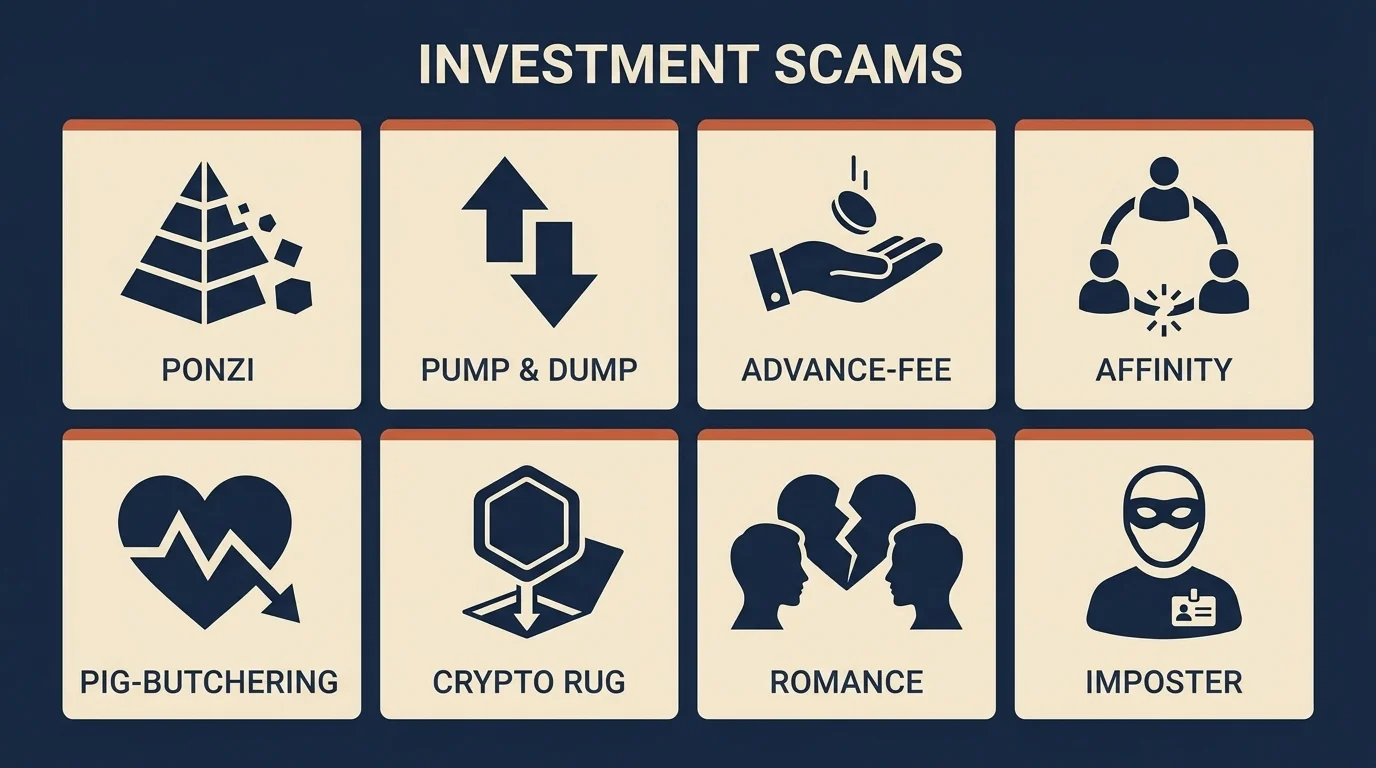
The eight common investment scams
A short taxonomy. There are more than eight; these are the ones that account for the majority of 2025-era losses and that you should recognise on contact.
1. Ponzi and pyramid schemes. Returns to existing investors are paid from new investor inflows rather than from underlying investment returns. They collapse when new inflows slow. The pattern is older than the SEC and it has never gone away.
2. Pump-and-dump. Promoters accumulate a thinly-traded security cheaply, generate artificial demand through coordinated promotion (now frequently social-media or Telegram-driven), then sell into the inflated price. Retail buyers are left holding the position as it collapses.
3. Advance-fee fraud. The investor is asked to pay a fee in advance to unlock a much larger return or release a trapped sum. The fee disappears. The larger return never existed.
4. Affinity fraud. A scheme targeted at members of a defined community — religious, ethnic, professional, alumni — where the scammer either belongs to or impersonates a member of the community. The trust signal of group membership substitutes for the due diligence the victims would otherwise have done.
5. Pig-butchering. I will give this one its own section below because it is the dominant 2025–2026 typology. In short: a long-cultivation scam that builds trust through social media or dating apps, layers in an investment platform showing manipulated gains, and disappears after the victim is fully committed. The Utah Division of Securities now treats it as a top-five scam category, and the DOJ Scam Center Strike Force in 2026 dismantled at least 9 Southeast Asian scam centers and arrested 276+ individuals running this category of fraud against Americans.
6. Crypto and rug-pulls. Scammers collected $1.5 billion in cryptocurrency from US victims through Q3 2025, up roughly 50% from the same period in 2024. Rug-pulls — where the team behind a token withdraws all liquidity once retail buying has lifted the price — are a specific subcategory. As someone who has watched two cycles, I want to be clear: this is not "crypto is a scam". It is that the channel is unregulated enough and the velocity of new tokens is high enough that scammers operate inside the legitimate part of the market without easy detection.
7. Romance-investment scams. Hybrid of social engineering and investment fraud — a romantic relationship built online, eventually pivoted into a "great investment opportunity my friend told me about". The investment platform is the scammer's platform. Often overlaps with pig-butchering as a delivery vector.
8. Imposter-broker scams. Scammers impersonate real registered brokers, RIAs, or even SEC and FINRA examiners — sometimes serving fake BrokerCheck reports. The Utah Division of Securities reports that impersonation of legitimate securities firms nearly doubled from 2023 to 2024, and this is now where AI weaponization is doing the most damage.
AI-era investment scams
The defining 2026 shift in this space is AI weaponization. The Utah Division of Securities flagged this as the central new threat for the year, and it shows up in four specific ways.
Deepfake video calls. Scammers now run live video calls using AI-generated likenesses of real advisors, celebrities, or even regulators. The lift in visual verification — "I saw the person, so they must be real" — has collapsed. Voice cloning has reached the same threshold.
AI-generated trade charts and dashboards. Scam platforms now serve manipulated portfolio dashboards showing fabricated gains, sometimes with realistic order books and "trade history" pulled from generative tools. These dashboards are the engine of pig-butchering — they are what convinces the victim to deposit more.
AI washing. Scammers falsely claim their tool uses AI for an algorithmic edge ("our AI predicts the next 100 trades"). The claim is unverifiable, the "edge" does not exist, and the term is now broad enough to launder any number of underlying schemes.
Synthetic property and asset renderings. AI-generated real estate, fake company offices, fake yacht and luxury-asset stock photos populate the websites scammers use to project legitimacy.
The practical implication: visual verification — a video call, a slick website, a clean dashboard — is no longer a meaningful signal of legitimacy. The verification that matters now is regulatory verification (covered below) and provenance verification of the specific platform.
Related Article: Youth-Led Financial Revolutions: Crowdsourcing as a Catalyst for Investment Innovation
Anatomy of a pig-butchering scam
Because pig-butchering is the typology I see most frequently and the one with the highest median losses, the four-stage structure is worth naming explicitly.
Stage 1 — Contact. An unsolicited message on a dating app, social network, or chat platform. Sometimes a "wrong number" text that the scammer turns into a conversation. The contact is engineered to feel organic.
Stage 2 — Cultivation. Weeks or months of relationship building. No investment talk at this stage. The trust is the asset being constructed.
Stage 3 — The opportunity. Eventually the scammer mentions an investment platform — sometimes framed as a family member's tip, sometimes as their own discovery. The platform is the scammer's. The dashboard shows gains. Withdrawals at small scale appear to work.
Stage 4 — The vanish. Once the victim has committed enough capital, the dashboard shows extraordinary gains but withdrawals are blocked — usually with fee, tax, or anti-money-laundering excuses requiring additional deposits to "unlock" the funds. Eventually the platform, the dashboard, and the scammer all disappear.
The structural lesson is that the scam works because each stage looks innocent in isolation. The defense is to recognise that the entire sequence — unsolicited contact, long cultivation, opportunity introduced organically, dashboard-only verification — is itself the pattern, regardless of how legitimate any single piece looks.
Red flags: how to spot an investment scam
Roughly 30% of all scam-loss reports in 2025 started on social media; investment scams alone via social media drove $1.1 billion of those losses. The list below combines what the FTC, FINRA, and the DOJ now treat as the highest-signal red flags.
- Guaranteed or unusually high returns. No legitimate investment guarantees returns. Any pitch that does is either misframed or fraudulent.
- Pressure to act fast. Time-limited "windows" and fear-of-missing-out framing are designed to short-circuit the verification step.
- Unregistered seller or unregistered security. If the person and the offering are not registered with the SEC, FINRA, or a state securities regulator, the question is not "is this a good deal" — it is "why is this person operating outside the system".
- Deposits via crypto, wire transfer, or gift card. These are non-reversible payment rails. Legitimate registered investments do not require them.
- High-minimum traps. FINRA reports that fraudulent apps now demand $200,000+ minimums to lock victims in — turning the deposit itself into the trap.
- Deepfake video calls or AI-washed claims. Per the Utah Division of Securities, both are now common impersonation vectors.
- Off-platform contact. Pitches that move from the original platform to encrypted chat (Telegram, WhatsApp, Signal) at the scammer's request are isolating the victim from any review by others.
- Character-substituted URLs. FINRA's imposter-scam page calls out the pattern explicitly — "1" substituted for "l", ".co" for ".com", Cyrillic look-alikes for Latin characters. The url is the cheapest possible verification step and the one scammers count on you skipping.
- Mobile-app developer mismatch. Apps where the developer name on the store does not match the firm name on the website or marketing materials.
- Investment "clubs" recruiting via social media. Encrypted-chat groups that promise group-coordinated trades are an updated form of pump-and-dump.
- Finfluencer pressure. About 24% of investors report feeling pressured to act quickly on unsolicited finfluencer advice. If the entry point into the investment is a creator post rather than a credentialed source, it is awareness content at best — not an action signal.
If two or more of these flags appear in the same pitch, treat that pitch as a probable scam until verified.
Related Article: Red vs. Blue: The Battle of Colors in Investment Marketing
Suitability, Reg BI, and the bright line between unsuitable and fraudulent
I want to draw a distinction the financial media routinely loses, because it changes the response.
A legitimate registered broker who recommends an investment that does not fit your financial situation, risk tolerance, or time horizon is operating against FINRA Rule 2111 — the suitability rule. The rule requires brokers to have a reasonable basis to believe a recommendation is appropriate for the specific customer. A separate, broader standard — SEC Regulation Best Interest (Reg BI) — requires brokers to act in the retail customer's best interest at the time of a recommendation. Both regimes have enforcement infrastructure. If your broker has violated Rule 2111 or Reg BI, your path is a FINRA arbitration claim or a complaint to your state securities regulator. It is not a criminal matter.
An unregistered actor — a person who is not a broker, not a registered investment adviser, and not a fiduciary — who solicits you for an investment is operating outside this framework entirely. If they take your money under false pretenses, the response is criminal, not regulatory: you report to the SEC, the FTC, the FBI's IC3, and your state securities regulator. The recourse is restitution through enforcement, not arbitration.
The bright line, practically:
- If the person is on FINRA BrokerCheck and the issue is suitability or fee disclosure → arbitration / state regulator → likely civil resolution.
- If the person is not on FINRA BrokerCheck or SEC IAPD → criminal report → law enforcement and probable loss.
This is the most important sentence I can give you as a reader of consumer-protection content: the first verification step does the most work. If the advisor or platform is not in the regulatory system, no amount of policy debate about Reg BI helps you.
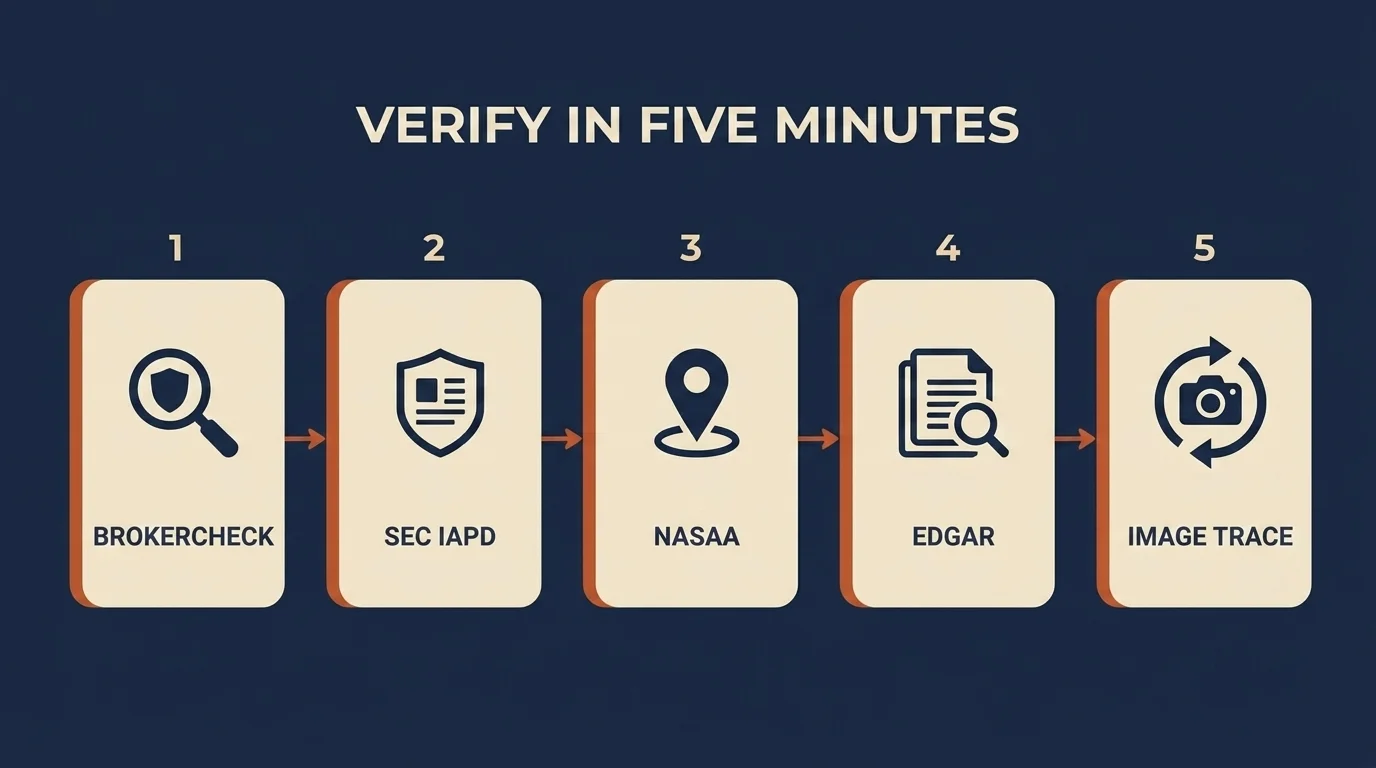
Verify in five minutes
The verification stack is short and free.
- FINRA BrokerCheck (brokercheck.finra.org). The FINRA-run database for registered brokers and brokerage firms. Search by name. If the person claims to be a broker and is not in BrokerCheck, the conversation is over.
- SEC IAPD (adviserinfo.sec.gov). The SEC's Investment Adviser Public Disclosure database — covers registered investment advisers (RIAs) and their representatives. Same search principle.
- NASAA state regulator lookup (nasaa.org). State securities regulators license advisors and brokers whose business is local to that state; some bad actors are excluded from federal databases but show up here.
- SEC EDGAR (sec.gov/edgar). For any registered securities offering — the SEC's filing system. If a private offering is supposedly real, it should have a Form D filing on EDGAR.
- Reverse image search and basic web-trace. Search the advisor's profile photo and the platform's hero images. If they appear on multiple unrelated sites or stock-photo sources, treat that as a high-severity flag.
That stack catches a substantial fraction of imposter-broker, advance-fee, and Ponzi cases before any money moves.
Questions to ask before you invest
If you have made it past verification and are evaluating a legitimate registered advisor, the questions below are the ones I would put on the table before signing anything.
- Are you registered as a broker, an investment adviser, or both? Show me your BrokerCheck or IAPD entry.
- Who is the custodian holding the assets — a regulated, named entity, or the firm itself?
- What fees do you charge — all of them, including third-party revenue sharing, 12b-1 fees, and load shares?
- Are you acting as a fiduciary in this relationship, or to a best-interest standard, or to a suitability standard?
- What is the written rationale that this specific recommendation fits my financial situation, objectives, and risk tolerance?
- What are the exit terms — surrender charges, redemption windows, lockups?
- What conflicts of interest do you have on this product? Is anyone paying you to recommend it?
- Who is the regulator I would contact if I have a complaint, and what is the arbitration or mediation pathway?
If a registered advisor will not answer any of these in writing, that itself is a signal.
What to do if you've been scammed
If you have already lost money to a suspected investment scam, the workflow below is the canonical one in the US. None of it is legal advice — but each step is documented by the agency listed and is free to use.
- Stop all contact with the scammer. Do not negotiate, do not respond to requests for additional deposits, do not engage with anyone who contacts you offering to "recover" the lost funds (that secondary scam — recovery fraud — is itself a documented typology).
- Document everything. Screenshot every communication, every dashboard, every transaction record, every URL. Save it offline.
- Report to the SEC via the Tips, Complaints, and Referrals system at sec.gov/tcr.
- Report to the FTC at ReportFraud.ftc.gov.
- Report to the FBI at IC3.gov — the Internet Crime Complaint Center.
- Report to your state securities regulator via the NASAA lookup.
- Contact a securities attorney. Recovery is hard and partial; an attorney can advise on FINRA arbitration (if a registered broker was involved) or civil litigation paths.
A safety note on this section: none of this is legal advice. If you have lost funds, your situation is specific to facts I cannot see — the jurisdiction, the regulatory status of the actor involved, the size of the loss, whether the funds went to a custodial or self-custodial address — and the right next step depends on them. A licensed securities attorney is the right next call.
What would change my view
I want to close by naming what I would watch for, because the picture I have painted of investment scams in 2026 is shaped by one specific assumption: that the AI weaponization wave is in its early stages and will get worse before it gets better. Two things would change my view.
The first would be a measurable drop in the impersonation-doubling trend the Utah Division of Securities flagged — sustained for two consecutive reporting periods. That would suggest the regulatory and platform-level defenses have started catching up to the offense.
The second would be a structural change to how non-reversible payment rails — crypto, wire, gift cards — interact with consumer protection. As long as the dominant scam-funding rails are non-reversible, the offense has a structural advantage that no consumer-side checklist can fully close.
Until either of those things happens, the verification stack and the red-flag checklist in this article are the most reliable defense available. None of this is individual financial or legal advice. If you are evaluating a specific investment or you have been scammed, the right next conversation is with a fiduciary planner, a securities attorney, or both — not a single article.
Frequently Asked Questions
The eight that account for the majority of 2025-era losses are Ponzi/pyramid schemes, pump-and-dump, advance-fee fraud, affinity fraud, pig-butchering, crypto and rug-pulls, romance-investment scams, and imposter-broker scams. AI-driven impersonation — deepfake video calls, AI-generated trade dashboards, AI-washed product claims — now appears across all eight. The DOJ Scam Center Strike Force dismantled at least 9 Southeast Asian scam centers and arrested 276+ individuals running these schemes against Americans in 2026.
Run the five-step verification stack: (1) FINRA BrokerCheck at brokercheck.finra.org for registered brokers; (2) SEC IAPD at adviserinfo.sec.gov for registered investment advisers; (3) your state securities regulator via the NASAA lookup at nasaa.org; (4) SEC EDGAR at sec.gov/edgar for any specific registered offering; (5) reverse image search on the advisor's profile photo and the platform's hero images. If the advisor is not in any of the first three databases, that is the red flag — no amount of polished website matters.
Stop all contact with the suspected scammer (and ignore anyone who contacts you offering to 'recover' the funds — that is a documented secondary scam). Document every communication and dashboard with screenshots. Report to the SEC at sec.gov/tcr, the FTC at ReportFraud.ftc.gov, the FBI at IC3.gov, and your state securities regulator via NASAA. Then contact a securities attorney — recovery is partial and specific to your jurisdiction. None of this is legal advice, but each step is documented and free.
FINRA Rule 2111 is the suitability rule that requires brokers to have a reasonable basis to believe an investment recommendation is appropriate for the specific customer's financial situation, objectives, and risk tolerance. SEC Regulation Best Interest (Reg BI) adds a broader standard requiring brokers to act in the retail customer's best interest at the time of a recommendation. If a registered broker has violated either rule, your path is a FINRA arbitration claim or a complaint to your state securities regulator — civil recourse, not criminal. This is different from an actual scam, which requires a criminal report.
Scammers now use AI in four ways. Deepfake video calls impersonate real advisors, celebrities, or even regulators in real time. AI-generated trade charts and dashboards show fabricated portfolio gains that convince victims to deposit more — the engine of pig-butchering scams. 'AI washing' is the claim that a tool uses AI for algorithmic edge when no such edge exists. Synthetic property and asset renderings populate scam websites to project legitimacy. The practical implication is that visual verification — a video call, a slick website, a clean dashboard — is no longer a meaningful signal. Regulatory verification (BrokerCheck, SEC IAPD, NASAA) is.
Pig-butchering is a four-stage scam: (1) contact — unsolicited message on a dating app, social network, or 'wrong number' text; (2) cultivation — weeks or months of trust-building with no investment talk; (3) the opportunity — an investment platform is introduced as a family member's tip or personal discovery, with a dashboard showing manipulated gains and small withdrawals appearing to work; (4) the vanish — once enough capital is committed, withdrawals are blocked behind fee or tax demands, and the platform disappears. State regulators now treat pig-butchering as a top-five scam category, and the DOJ has begun coordinated international takedowns of the scam centers running it.
Defense rests on three layers. First, the verification stack — BrokerCheck, SEC IAPD, NASAA, EDGAR — catches imposter actors before money moves. Second, the red-flag checklist (guaranteed returns, pressure to act fast, unregistered seller, crypto/wire payment demand, $200K+ minimums, deepfake calls, off-platform contact) catches social-engineering patterns. Third, awareness of the difference between an unsuitable recommendation (FINRA Rule 2111 / Reg BI, with civil recourse) and an actual scam (criminal, with law-enforcement recourse) lets you respond proportionately if something goes wrong.