
Millionaires


When I finally took my specialty-food company past seven figures, there were two numbers in the room and they were not the same number. The one on the front of the press release was revenue — the loud number, the one people congratulate you for. The number that actually made me a millionaire was net worth: what the business was worth minus what I still owed on it, and that number moved on a completely different clock. Most people picture millionaires as inherited money or an overnight tech exit. The 2026 data says almost the opposite. There are more of them than ever, and the overwhelming majority built it themselves — slowly, on ordinary incomes. This guide covers what actually counts as a millionaire, how many there are, why most are self-made, and the specific path an ordinary earner takes to get there. It is education, not individual financial advice.
There Are More Millionaires Than Ever — and Most Made It Themselves
About 23.6 million American adults are millionaires — over 40% of the world's roughly 58 million — and 2025 alone minted about 440,000 new US millionaires.
That is not a rounding artifact; it is a record. Stock-market and asset gains added nearly a million new millionaires worldwide in 2025 — more than 2,600 a day, according to the UBS Global Wealth Report 2026, and the United States produced almost half of them. The more interesting number sits underneath the headline: UBS now tracks a segment it calls "everyday millionaires" — households with $1 million to $5 million in investable assets — and that group has more than quadrupled since 2000, reaching about 52 million globally. The typical millionaire is no longer a dynasty. It is a saver-investor who did the boring thing for a long time. That is the bridge to the rest of this piece: here is how many there are, and the surprising part is how most of them got there.
One operator's warning before the numbers: state the definition every time, or the counts lie to you. The gap between the two main methods is not noise — it is the whole story.
How many millionaires are there in the US and the world?
| Measure (2026 reports) | Figure | Basis — firm |
|---|---|---|
| US millionaire adults | ~23.6 million | Net worth ≥ $1M — UBS |
| World millionaires | ~58 million | Net worth ≥ $1M — UBS |
| World high-net-worth individuals | ~25.3 million | Investable assets ≥ $1M, excl. home — Capgemini |
| New US millionaires, 2025 | ~440,000 (UBS) / ~736,000 (Capgemini) | Definition-dependent |
| New millionaires globally, 2025 | ~1 million (>2,600/day) | Net worth basis — UBS |
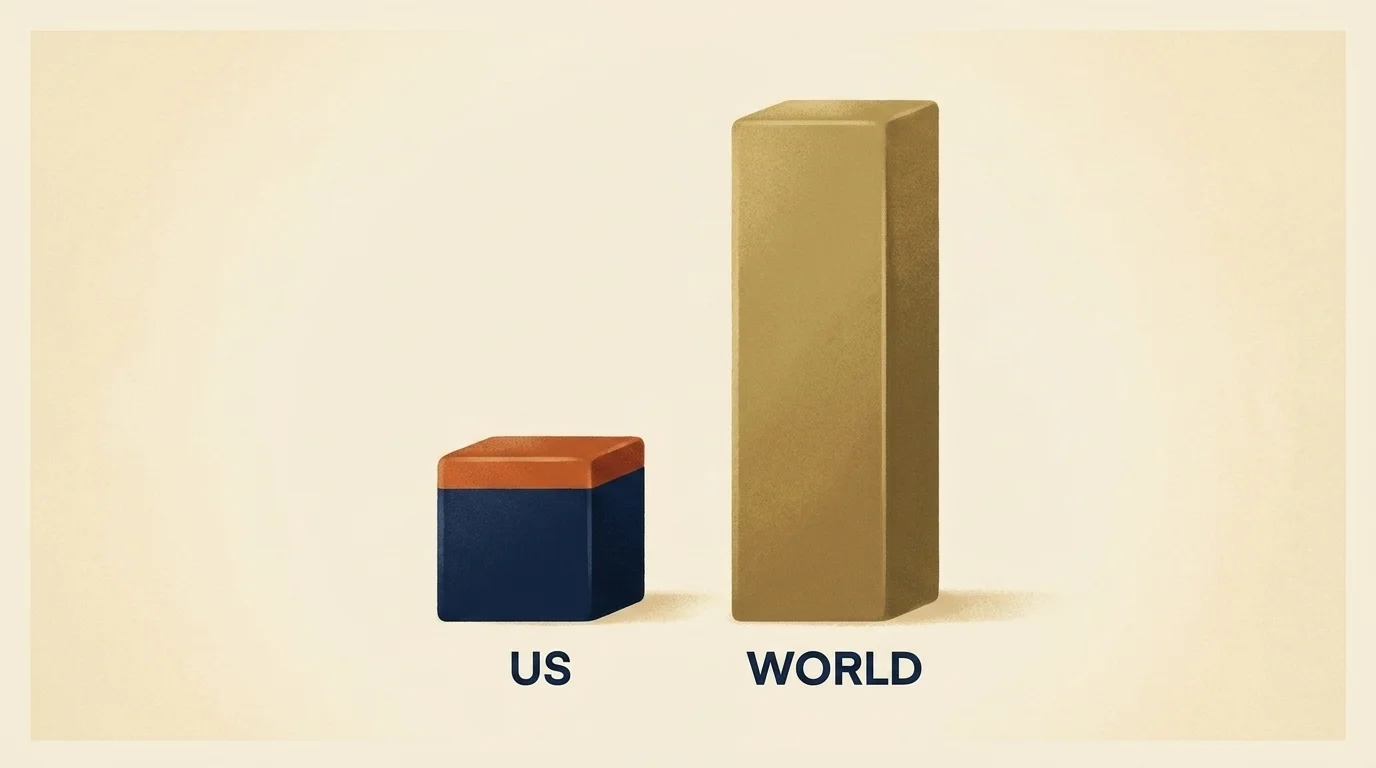
HNWI vs. net worth: why the counts disagree
The two big reports count different things. UBS uses total net worth — everything you own, including home equity and retirement accounts, minus debt — which is why it lands near 58 million worldwide. Capgemini counts only "high-net-worth individuals" with at least $1 million in investable assets, excluding your primary residence, a stricter bar that lands near 25.3 million HNWIs worldwide, with the US adding about 736,000 in 2025 — roughly 1,200 a day. Same reality, two rulers. When a headline throws a millionaire count at you, the first question is which ruler — because the answer changes the number by tens of millions. This is an entrepreneurship habit as much as a statistics one: know which line on the statement you are reading before you react to it.
What Actually Counts as a Millionaire?
A millionaire is anyone whose net worth — total assets minus total debts — is at least $1 million. It is not $1 million sitting in cash.
The dictionary version is dry and correct: a millionaire is "an individual whose net worth or wealth is equal to or exceeds one million units of currency." Net worth, not income and not a bank balance. It is the same measure the Federal Reserve uses to track household wealth in its Survey of Consumer Finances: add up what you own — home equity, retirement accounts, investments, the value of a business you control — and subtract what you owe. If the remainder clears seven figures, you qualify, even if your checking account holds four.
Net worth vs. cash: what $1 million really means
This is where the word misleads people. A paid-off house, a healthy 401(k), and a small business can add up to a millionaire net worth while the owner still watches grocery prices. A millionaire net worth is a threshold, not a lifestyle, and $1 million buys materially less than it did a generation ago. From an operator's chair this is the same trap as reading the P&L instead of the cash account: the headline number and the real number are different things, and net worth is the honest one. It is what you keep, not what you gross.
Most Millionaires Weren't Born Rich
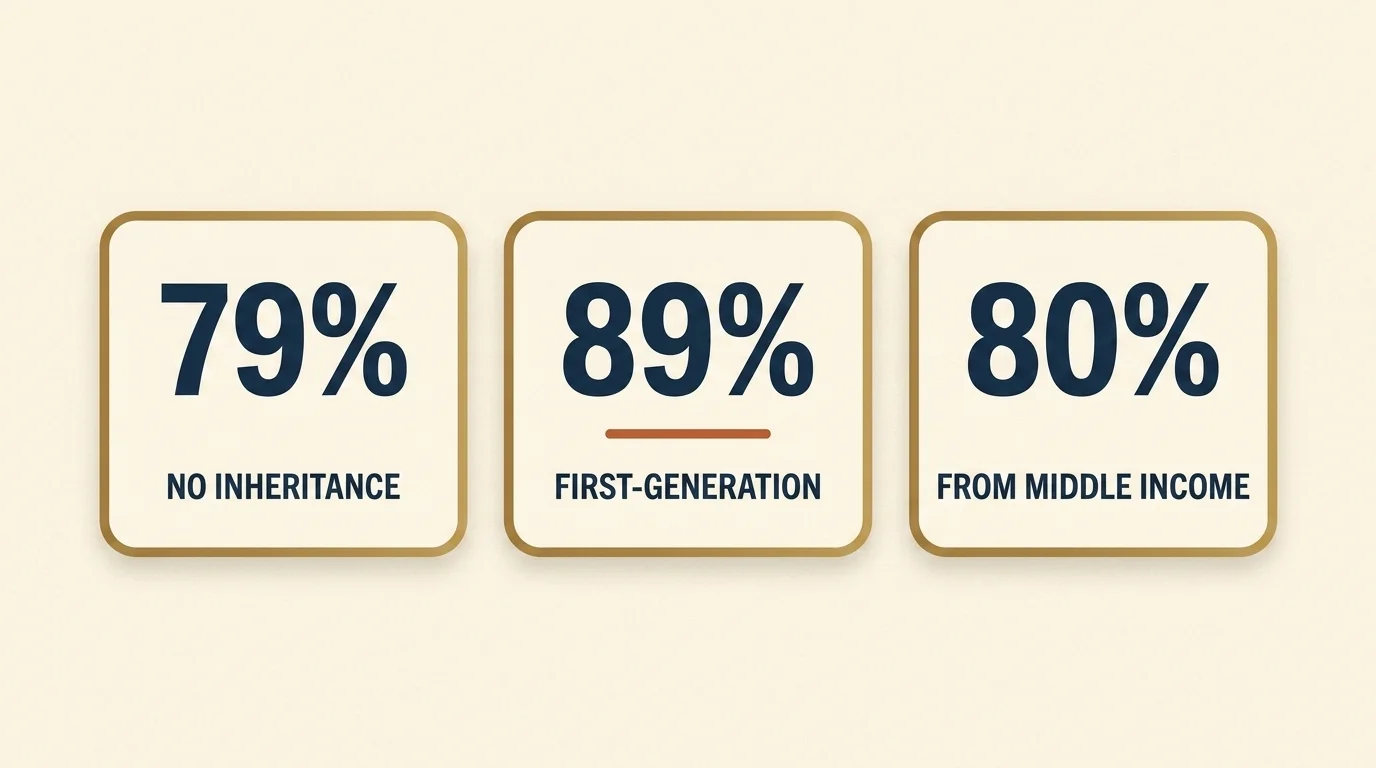
Most millionaires are self-made: Ramsey's study of 10,000 found 79% received no inheritance, and 89% are first-generation millionaires.
The picture of the trust-fund heir is mostly wrong. In Ramsey's National Study of Millionaires — 10,000 participants, the largest survey of its kind — 79% received no inheritance from their parents or family, 89% are first-generation millionaires, and 80% came from families at or below middle income. A striking 31% never earned a six-figure household income in a single working year; they averaged under $100,000 and still crossed the line. Compare that with an older reference point often cited from Barclays data, where about 16% inherited their fortunes and roughly 47% were business owners — the built-it path, not the born-into-it one.
What the data says about self-made wealth
Put the two data sets together and the story rewrites itself. The count is rising and the origin is ordinary — the modern millionaire is far more likely to be a disciplined earner than an heir. This is the entrepreneurship version of a distinction I make constantly: profitable and fundable are different games, and so are inherited and built. Nobody handed me a business; I made payroll through quarters that scared me, and the equity that eventually counted toward my net worth was built one retained dollar at a time. Wealth compounded on an ordinary income is a repeatable process, which is exactly why it belongs in the same conversation as building generational wealth rather than luck.
How to Become a Millionaire: The Four-Lever Playbook
To become a millionaire, maximize your income, live well below your means, and consistently invest the gap in index funds and tax-advantaged accounts. That is the entire mechanism; the rest is discipline and time.
The strategy search engines now summarize for "how to become a millionaire" reduces to four levers — maximize earnings, protect the gap, let compounding work, and build wealth-generating assets. It is the same slow-and-steady, systematic-investing principle that university extension programs have taught for decades, including Rutgers Cooperative Extension's personal-finance materials. None of it is exotic. What follows is education on how the levers work, not a personalized plan — returns are never guaranteed, and a licensed advisor should weigh your specific situation.
1. Maximize your earnings
Early on, income is the biggest lever, not frugality. You can only cut expenses down to zero, but the top line has no ceiling — high-income skills, deliberate raises, and side income all widen the gap you have to work with. Treat your earnings the way a business treats its top line: something you actively grow, not a fixed input you optimize around.
2. Protect the gap
The gap between what you earn and what you spend is the whole game. Living below your means is not deprivation; it is the surplus that gets invested. In operator terms, that gap is your retained earnings — the money the business keeps to reinvest — not "leftover" money to spend if it happens to survive the month. Protect it on purpose.
3. Let compound interest do the work
Invest the gap consistently in low-cost index funds or ETFs inside tax-advantaged accounts like a 401(k) or IRA, and let time compound it. Consistency beats brilliance here; the investor who contributes every month for twenty years usually beats the one hunting for the perfect entry. This is the lever most people underweight because it is boring, and boring is the point. Sound investment strategies are repetitive by design.
4. Build wealth-generating assets
The fastest self-made compounding usually comes from assets that produce their own returns — real estate, equity in a business, and multiple income streams that do not depend on your hours. This is the entrepreneurship lever, and it is where an owner's instincts separate from a saver's. The specific math on how fast the gap becomes $1 million comes next.
How Much Do You Need to Invest to Reach $1 Million?
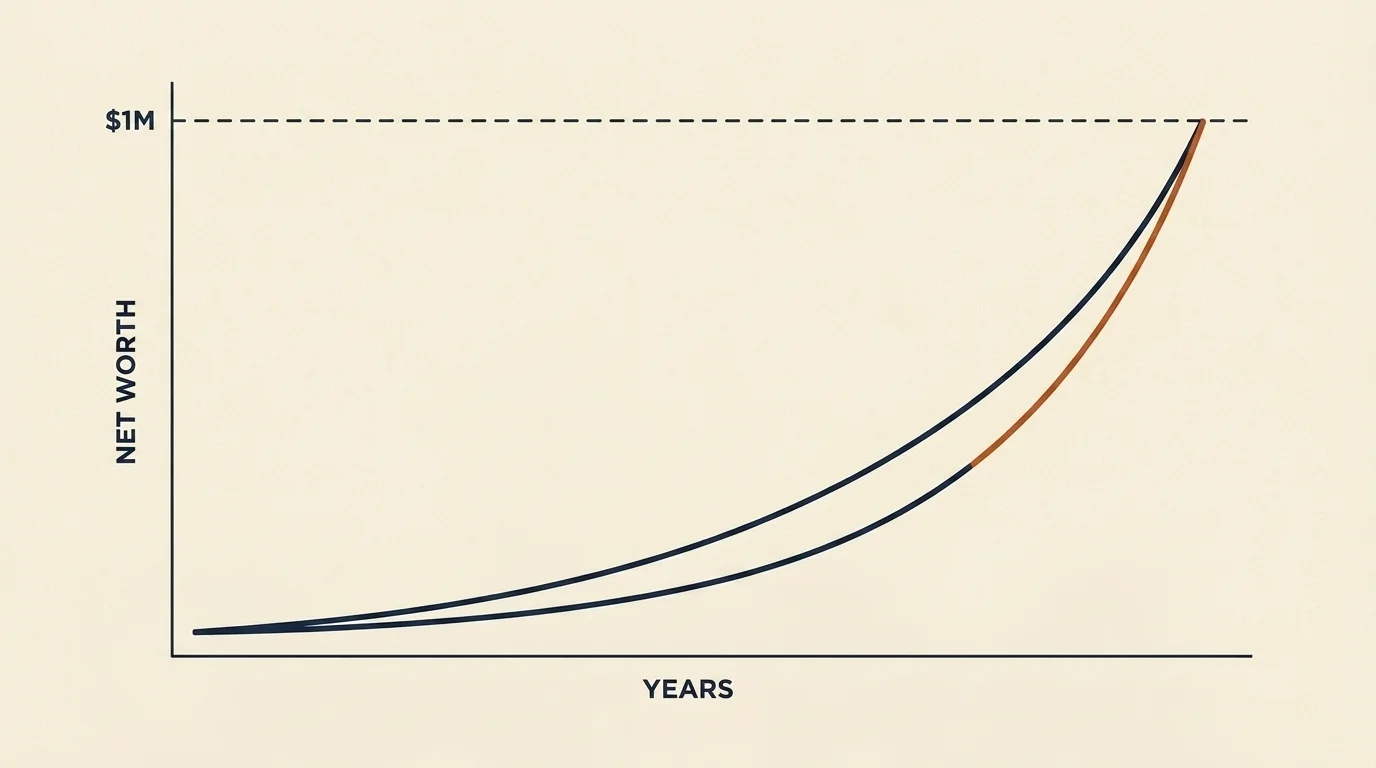
Investing about $43,000 a year at a 6% real return reaches roughly $1 million in about 15 years — time does most of the work.
That benchmark comes from a widely cited Money With Katie calculation, and it is worth treating as an illustration rather than a promise: real returns vary, markets fall, and no single year is average. Still, the shape of it holds. The variable that matters most is not the size of each contribution but how early and how consistently you make them, because compounding does its heaviest lifting in the final stretch. Someone who starts a decade earlier with smaller amounts often finishes ahead of someone who starts late and contributes more.
The compound-interest math
Here is the check I would run this week, and it is the same one I run on my own numbers every Sunday morning. Pull one month of spending. Find the gap between what came in and what went out — your investable surplus. Drop that monthly figure into any compound-interest calculator at a 6% real return and read the years-to-$1-million off the result. If the gap is a real number, you now have a timeline instead of a wish. If the gap is zero, the market is not your problem — levers one and two are, and that is where the work actually starts.
The Habits That Separate Millionaires From Everyone Else
Self-made millionaires share a few unglamorous habits: they avoid consumer debt, automate their investing, and make decisions on a decade horizon.
None of that requires a personality you were born with. The behaviors behind the self-made data are closer to accounting hygiene than genius. Consumer and high-interest debt is the anti-compound — it runs the same exponential math against you that index funds run for you, which is why people who build wealth treat it as an emergency rather than a lifestyle. And the horizon is long: decisions get measured in decades, not paychecks, so a bad quarter in the market reads as noise instead of a reason to sell.
Consistency beats intensity
The quiet engine under all of it is automation. Move the contribution the day the paycheck lands, before willpower gets a vote, and consistency stops depending on how motivated you feel that month. My own version of this is the spreadsheet I still update every Sunday morning — not because the numbers swing dramatically week to week, but because reviewing your own figures on a schedule is the actual habit. The millionaire mindset people write about is mostly this: a boring, repeated review that keeps small leaks from becoming structural ones. Intensity is a weekend. Consistency is a decade.
The Honest Scoreboard
The 2026 numbers take the mystery out of the word millionaires. There are more of them than ever, most were not born into it, and the path is unglamorous and repeatable: earn more, protect the gap, invest it consistently, and give it time. Net worth is the honest scoreboard — not revenue, not a press-release number, and not what shows up in anyone's driveway. So run the check this week: find your investable gap and calculate your own years-to-$1-million at a 6% real return. If the gap is zero, that is not a failure, it is the starting line. And because this is education rather than individual financial advice, take your specific plan to a licensed advisor before you act on it.
Frequently Asked Questions
About 23.6 million American adults are millionaires — over 40% of the world's roughly 58 million millionaires (UBS Global Wealth Report 2026).
Roughly 8–9% of US adults have a net worth of $1 million or more, depending on whether home equity and retirement accounts are counted.
Yes. In Ramsey's study of 10,000 millionaires, 79% received no inheritance and 89% were first-generation — the wealth was built, not inherited.
A millionaire has a net worth (assets minus debts) of at least $1 million — not necessarily $1 million in cash.
Maximize income, live well below your means, and consistently invest the gap in index funds and tax-advantaged accounts so compound interest does the heavy lifting.