Unveiling Rural Resilience: Financial Empowerment Initiatives in Small-Town America


In 2024, 40% of rural small businesses received only partial funding or no funding at all on the applications they submitted — nearly twice the urban rate (Square, 2024). The same year, rural founders who did get funded saw a 59% full-approval rate — modestly higher than the 50% urban rate (Fundwell, 2026). And remote rural businesses post a 72% five-year survival rate, materially above urban averages. The story those three numbers tell together is not the one most coverage of small town business ideas tells: rural founders who make it past the funding wall outperform on durability, but the wall is real, and it sits in a different place than the wall urban founders climb.
For founders working on a small-town business idea — restaurant, retail, manufacturing, agricultural value-add, professional services — the relevant question in 2026 is rarely "is my idea good." It is "which capital intermediary should I be talking to first." The federal architecture of rural finance is unusually rich, mostly underused, and surprisingly hard to map without help. The institutions that matter — USDA Rural Development, the SBA, the CDFI Fund, the OFN locator, and the post-2025 Opportunity Zones map — all exist, all fund real businesses every quarter, and almost none of them appear in the listicle pages that currently dominate the SERP for "small town business ideas." This piece is the bridge: the ideas, the named programs that fund them, and the comparison table that maps one onto the other.
What the rural funding picture actually looks like in 2026
Most coverage of rural small-business finance still treats community development financial institutions (CDFIs) as a curiosity. The 2025 Richmond Fed CDFI Survey puts that framing to rest. Rural CDFIs reported rising borrower demand through 2024, and 38% of them now name small-business finance as their primary line of business — versus 26% of non-rural CDFIs. Roughly 70% of rural CDFIs depend on federal funding as a major source of capital, which is both their strength (mission-aligned, patient money) and their structural constraint (a federal budget cycle that does not always match a founder's launch window).
The CDFI Coalition reports that CDFIs collectively originate over $1.3 billion in microloans annually, typically under $50,000 each. The CDFI Fund's Small Dollar Loan Program contributes around $9 million per year in grants to backstop that pipeline. Separately, the New Markets Tax Credit program has seen a 20% increase in investments flowing to rural and non-metro communities (CDFI Fund), channeled into rural hospitals, small manufacturing, and main-street redevelopment.
Read together: the capital exists, the demand exists, and the gap between them is mostly a discovery problem — founders not knowing which intermediary to call, and intermediaries not always reaching the founders who would qualify. The rest of this article is a directory of the calls worth making.
CDFIs: the community-capital instrument the rest of the SERP doesn't explain
A community development financial institution is a federally certified mission-driven lender — a bank, credit union, loan fund, or venture fund — whose primary purpose is to serve low-income people or communities that mainstream financial institutions underserve. There are over a thousand of them across the United States, and several hundred have meaningful rural footprints.
For a small-town founder, the practical questions are: who are they, how do I find one in my county, and what do they actually offer that a regional bank does not?
- Find one: the OFN CDFI Locator and the CDFI Fund directory both let you search by state and county. Most rural-active CDFIs list small-business loans, microloans, and community-facility loans. Free business counseling is usually bundled with the loan — that is part of what the CDFI mission funds.
- What they offer that a bank does not: longer underwriting timelines, willingness to lend on character and community standing alongside collateral, and a structural mandate to evaluate the additional benefit of the loan to the community. The same loan that a regional bank declines because the founder has no W-2 income history will often be approved by a CDFI that can underwrite the cashflow of the existing small business or the realism of the operating plan.
- Where they fall short: the federal-funding dependency cited in the Richmond Fed survey is the real one. When federal appropriations cycle, CDFI lending capacity can tighten. A founder running a time-sensitive plan should ask the CDFI directly about its current funding posture before committing the timeline of the business launch to a CDFI loan as the sole capital source.
The honest question to put to any community-capital instrument — CDFI loan, NMTC investment, Opportunity Zone equity — is the one that institutional sustainable investing asks of itself: what, specifically, remains true about the investment after the lender exits, and for whom? CDFIs answer that question more clearly than most. The borrower keeps the business, the community keeps the storefront, and the CDFI keeps the loan on the books long enough for the relationship to compound. That is what additionality looks like at street level. It is also why a CDFI loan tends to take longer to close than a conventional bank loan: the additionality work is real work.
USDA Rural Development: the program list, named and dated
USDA Rural Development runs more than forty discrete business and infrastructure programs. The handful that matter to most small-town founders, with current sizing:
- Rural Business Development Grant (RBDG) — $10,000 to $500,000 for rural businesses with fewer than 50 employees and less than $1 million in revenue. Funded through nonprofit intermediaries and rural cooperatives. Best fit for early-stage capital needs that fall below most bank thresholds. USDA RBDG page.
- Rural Microentrepreneur Assistance Program (RMAP) — operating-capital loans and grants targeted at firms with ten or fewer employees, delivered through microenterprise development organizations.
- Value-Added Producer Grant (VAPG) — up to $250,000 for agricultural producers converting raw commodities into higher-margin value-added products (cheese, jam, cured meats, processed crops). The current cycle has a posted deadline of April 22, 2026, 1pm ET — a date worth circling for any agricultural founder considering a value-add expansion this year.
- RISE Grants (Rural Innovation Stronger Economy) — up to $2 million over four years for business incubators, training facilities, and innovation hubs in rural communities. Best fit for nonprofit-led or coalition-led ecosystem investment, not a single founder.
- USDA Business & Industry (B&I) Loan Guarantee — up to $25 million per project, originated by commercial lenders with USDA backing the loan. Best fit for larger rural businesses scaling capacity, not first-time founders.
- Farm Service Agency direct operating loans — up to $400,000 for farm operating expenses, with FSA as the direct lender for producers who cannot obtain conventional credit.
The federal sticker shock is real — $25 million B&I, $2 million RISE, $500,000 RBDG — and most of it is not for the first-year solo founder. The right sequencing for a small-town founder is usually CDFI or SBA Microloan first (for the launch capital), VAPG or RBDG second (for the documented expansion), and B&I or NMTC third (for the scale step). Skipping the early rungs is rare and not particularly recommended.
SBA programs that work for rural founders
The Small Business Administration sits alongside USDA, with overlapping mandates but a non-rural-specific design. The programs that consistently work in small-town America:
- SBA Microloan — $500 to $50,000 per loan, originated through SBA-approved nonprofit intermediaries, many of which are also CDFIs. The practical implication: the same intermediary often offers both SBA Microloans and non-SBA CDFI microloans, and the right product depends on timeline (SBA tends to be slower-but-cheaper) and counseling needs (both include counseling, but with different structures). SBA Rural Businesses page.
- SBA 7(a) — up to $5 million, originated by SBA-approved banks and credit unions. The workhorse loan for established rural small businesses. The relevant question is which local bank or credit union holds a Preferred Lender Program designation, because PLP designation materially shortens decision time.
- SBA 504 — used primarily for fixed-asset purchases (commercial real estate, major equipment). Often the right structure for a rural founder buying a storefront rather than leasing it.
- SBA SBIR/STTR (America's Seed Fund) — over $4 billion per year in early-stage R&D capital. Notably underused by rural founders, partly because the application process assumes a research-institution adjacency that rural founders without university proximity have to construct deliberately. For rural founders in advanced manufacturing, agricultural technology, or rural-applicable health technology, SBIR is worth a conversation with the state's SBDC before assuming it does not apply.
Opportunity Zones 2.0 and rural America
The 2025 One Big Beautiful Bill Act made the Opportunity Zone program permanent, removing the sunset that had constrained the 2017 program's long-term planning utility. In 2026, governors nominate new census tracts. Treasury then designates a new OZ 2.0 map that takes effect from January 2027 through 2036. The eligibility criteria have tightened: qualifying tracts now require a poverty rate of at least 20% or a median family income at or below 70% of area median income, compared with the looser 2017 thresholds. That tightening is the part most coverage has missed: tighter thresholds structurally pull more rural tracts into the eligibility map. HUD Opportunity Zones; CDFI Fund OZ Resources.
For a rural founder, the practical implication is twofold. First: if the founder operates in a tract that is currently OZ-designated, the existing program's tax incentives for Qualified Opportunity Fund investment in the business remain available through 2026. Second: if the founder's tract is likely to be nominated under the new criteria, the right move in late 2026 is to track the governor's nomination process in the relevant state and prepare for the OZ 2.0 map's January 2027 effective date. A small-town business that becomes OZ-eligible under the new map gains a structural advantage in attracting outside equity capital from QOFs — patient, ten-year-hold capital that is unusually well-suited to building local businesses rather than flipping urban real estate (which was the dominant 2017-era critique of the program).
The additionality question still applies, and it is the question every rural community considering an OZ designation should ask of its own nominations: who benefits from outside capital flowing into the tract, and what protections exist for the local residents and businesses that were the eligibility justification in the first place? OZ 2.0 does not answer that question on its own. Local governance and community land trust structures — the patient-housing instruments that work alongside OZ equity — are how the answer gets shaped in practice.
Which funding route fits your small-town business?
The single most common question a rural founder asks the first time they walk into an SBDC or SCORE office is some version of "which program do I apply to first." The table below is a starting frame, not a substitute for the counselor conversation. Eligibility and timelines can change with appropriations cycles.
| Program | Max amount | Typical decision timeline | Free business counseling included? | Best fit for |
|---|---|---|---|---|
| CDFI Microloan (non-SBA) | Often $50,000 or less | 6–10 weeks | Yes | Pre-launch and early-stage founders without a strong banking history |
| SBA Microloan | $500–$50,000 | 8–12 weeks | Yes | Same audience, when the SBA-backed pricing is better than the CDFI's own product |
| USDA RBDG | $10,000–$500,000 | 3–6 months | Through intermediary | Established small rural businesses (<50 employees, <$1M revenue) needing growth capital |
| USDA VAPG | Up to $250,000 | 4–6 months | Through intermediary | Agricultural producers converting raw output into value-added products (FY26 deadline April 22, 2026) |
| USDA RISE | Up to $2M over 4 years | 4–6 months | Through intermediary | Nonprofit-led or coalition-led rural incubators and innovation hubs |
| SBA 7(a) | Up to $5M | 4–10 weeks (PLP shorter) | Through SBDC/SCORE | Established rural businesses with bankable cashflow; commercial-bank-originated |
| SBA 504 | Project-based | 6–12 weeks | Through CDC | Fixed-asset purchases — storefront, major equipment |
| USDA B&I Loan Guarantee | Up to $25M | 4–6 months | No | Larger rural businesses at scale step; commercial-bank-originated with USDA backing |
| Opportunity Zone equity (QOF) | Variable | Variable (deal-by-deal) | No | Rural businesses in OZ-designated tracts seeking patient outside equity capital |
A Main Street story
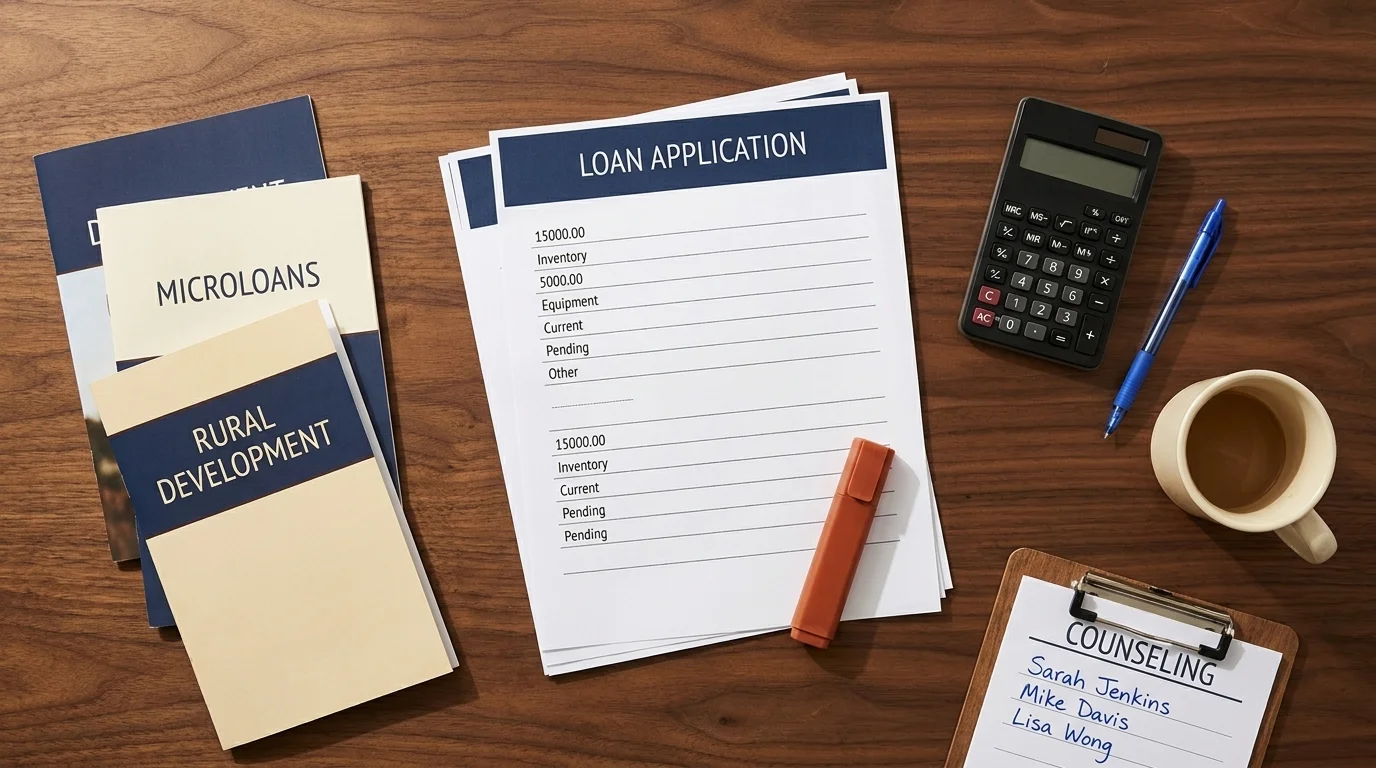
USDA Rural Development's newsroom regularly publishes short case studies of rural founders who used a specific program to launch or expand a small-town business. One pattern worth noting: the founders who appear in those case studies most often used a stacked-capital approach — a small CDFI loan or microloan for the initial launch, a USDA grant (typically RBDG or VAPG) for a documented expansion two to four years in, and a commercial bank loan with SBA or USDA guarantee for the scale step five-plus years in. Single-source capital, especially at launch, is the exception rather than the rule. The right reading for a founder is that no one of these programs needs to be sufficient; the question is which combination is, over the life of the business.
For founders looking for named cases as a research starting point, the USDA Rural Development newsroom and the CDFI Coalition's reporting on microlending impact publish ongoing rural founder case studies with named businesses and named programs. That is the right place to read for pattern recognition before designing a capital stack.
Financial literacy programs that actually reach rural communities
The literacy claim made by most rural-economic-development pieces is true at the level of need and weak at the level of delivery. The named programs that do reach rural communities, with measurable footprints:
- USDA NIFA Cooperative Extension financial literacy programming, delivered through land-grant university extension offices in every state. The most distributed rural financial-literacy infrastructure in the country, often the only one in counties without a four-year college.
- Junior Achievement Rural — extends JA's standard K–12 financial-literacy curriculum into rural school districts that the urban-focused JA chapters typically miss.
- RuralLISC technical assistance — the rural arm of Local Initiatives Support Corporation, providing technical assistance to rural CDFIs and community-development organizations that themselves run founder-facing literacy programs.
The pattern across all three: the program does not reach the rural founder directly. It reaches the institutions (extension offices, school districts, CDFIs) that reach the founder. A rural founder looking for financial literacy support is usually better served by contacting the closest USDA Cooperative Extension office or local CDFI than by searching for a national branded program.
Putting it together: the first calls to make
The institutions in this article exist, the capital exists, and the founders who use them tend to outperform on durability. The friction is almost entirely on the discovery side. For a small-town founder reading this in 2026, the three calls worth making in the first week:
- Call the closest CDFI — use the OFN locator to find one in your county or the adjacent county. Ask what small-business products they currently fund and what their decision timeline is for a loan in the $25,000–$50,000 range. The counseling is free and the first call is the longest-lasting relationship in the capital stack.
- Call your state's USDA Rural Development office — every state has one, and the program officer can tell you which of the forty-plus USDA programs apply to your specific situation. The state offices are the routing function the national-program-list page can't be.
- Find your SBDC or SCORE chapter — the Small Business Development Centers and SCORE volunteers offer free counseling and are the right intermediaries for SBA Microloan, 7(a), and 504 questions. They are also the right place to ask the SBIR/STTR question if R&D capital might apply.
The question worth sitting with at the end is the institutional one: who benefits and who bears the cost of how rural capital flows in 2026? The answer the federal architecture is currently betting on is that mission-aligned community lenders, federal grants targeted at rural-specific gaps, and the post-2025 Opportunity Zone refresh together produce a better answer for small-town founders than market capital alone would. The evidence for that bet — the 72% five-year survival rate, the rising CDFI demand, the NMTC rural surge — supports the framework, with the caveat the Richmond Fed survey already named: the federal-funding dependency is the lever that can swing the answer in either direction. Any rural founder building a long-horizon business should understand that lever, because it is part of the capital stack whether they planned for it or not.
None of this is individual business or financial advice. For specific funding decisions, the right next conversation is with an SBA-approved counselor, a CDFI loan officer, or a USDA Rural Development state office program officer who can see the specifics of your business that a published article cannot.
Frequently Asked Questions
Use the OFN CDFI Locator (ofn.org/cdfi-locator) or the CDFI Fund's directory at cdfifund.gov. Search by state or county; most rural-active CDFIs list small-business loans, microloans, or community-facility loans, and free business counseling is typically bundled with the loan.
The most accessible are Rural Business Development Grants ($10K–$500K for firms with <50 employees and <$1M revenue), the Rural Microentrepreneur Assistance Program (for businesses with ≤10 employees), Value-Added Producer Grants (up to $250K — FY26 deadline April 22, 2026), and the RISE grant (up to $2M over 4 years for incubators and innovation hubs).
Yes. The 2025 One Big Beautiful Bill Act made Opportunity Zones permanent. In 2026, governors nominate new census tracts; Treasury then designates an OZ 2.0 map that takes effect January 2027 through 2036. New eligibility (poverty rate ≥20% or median family income ≤70% of area median) structurally brings more rural tracts in.
Mixed. 40% of rural small businesses got only partial or zero funding on 2024 applications — nearly twice the urban rate. But rural founders who do qualify see a 59% full-approval rate (vs. 50% for urban), and remote rural businesses post a 72% five-year survival rate, materially above urban averages (Square, 2024).
SBA Microloans ($500–$50,000) are originated by SBA-approved nonprofit intermediaries — many of which are also CDFIs. CDFIs additionally offer non-SBA microloans funded through the CDFI Fund's Small Dollar Loan Program (~$9M/year in grants) and originate over $1.3 billion in microloans annually. Practically, the same intermediary often offers both, so ask which product fits your timeline and counseling needs.
The categories with the strongest combination of demand and rural-friendly funding routes are food and beverage (restaurants, value-added agricultural products eligible for USDA VAPG), retail and main-street services, healthcare-adjacent services (rural primary care, dental, home health), agricultural technology and value-add manufacturing, and hospitality. Idea matters less than capital fit — a strong idea without a viable funding stack does not survive year one.
Rural financial literacy delivery depends heavily on institutional intermediaries — USDA NIFA Cooperative Extension, rural school district JA chapters, and CDFI-run founder programs — rather than direct-to-consumer national brands. For a rural founder seeking literacy support, contacting the closest USDA Cooperative Extension office or local CDFI is typically more productive than searching for a national branded program.