
Redefining Financial Literacy through Interactive Social Media Initiatives


The honest starting point for any conversation about financial literacy campaigns in 2026 is this awkward number: 77% of Gen Z and 61% of Millennials now actively seek financial advice on social media or online, against 43% of Americans overall. The same audience is also the most-burned audience. An analysis of 2,470 stock-related videos targeted at young adults found that 71% of them contained misleading financial advice, and 37% of Gen Z viewers report getting into actual financial trouble after acting on something a creator said. The same survey found that 67% say online learning improved their financial situation. Both numbers are true. That is the central tension financial literacy campaigns on social media are now operating inside, and most of the existing writing on this topic ignores it.
This guide is what I wish were on the SERP when a real person looks up financial literacy resources in 2026. It is named campaigns, named creators, named apps, named regulators — not a thought-piece. I will tell you what is working, who to follow if you want to learn rather than be sold to, and how to check the credentials of anyone giving you advice in 60 seconds or less.
A planner caveat before we proceed: none of what follows is individual financial advice. The right financial decisions for your household depend on facts I cannot see from a blog post — your tax bracket, your time horizon, your specific account types. Treat this as a guide to better inputs for that conversation, not a substitute for a licensed advisor.
The literacy paradox
The single most useful framing I have seen for the state of financial education in 2026 is the paradox in the Social Capital Markets analysis: 67% of Gen Z and 60% of Millennials say online financial content has improved their financial situation; 37% of Gen Z and 25% of Millennials report getting into financial trouble because of advice from a creator. Both groups are using the same channel. The difference is what they are doing with it.
The audiences who report being helped are using social media for awareness: learning that a Roth conversion exists, hearing the words "expense ratio" for the first time, realizing they should check what their 401(k) is invested in. Awareness-level content is hard to do badly. Almost any explanation of how compound interest works will improve outcomes.
The audiences who report being burned are using social media for action: copying a specific trade, buying a specific token, signing up for a specific product because a creator endorsed it. Action-level content is where the same channel turns into a hazard, because it sits in the same feed as the awareness content but operates under entirely different rules.
The honest rule that follows is this: use social media for awareness, and route every action through a credentialed source or a fiduciary planner. The rest of this guide is the operational version of that rule.
The 2026 financial literacy campaign roster
The campaigns space has matured significantly in the past three years. A few worth naming.
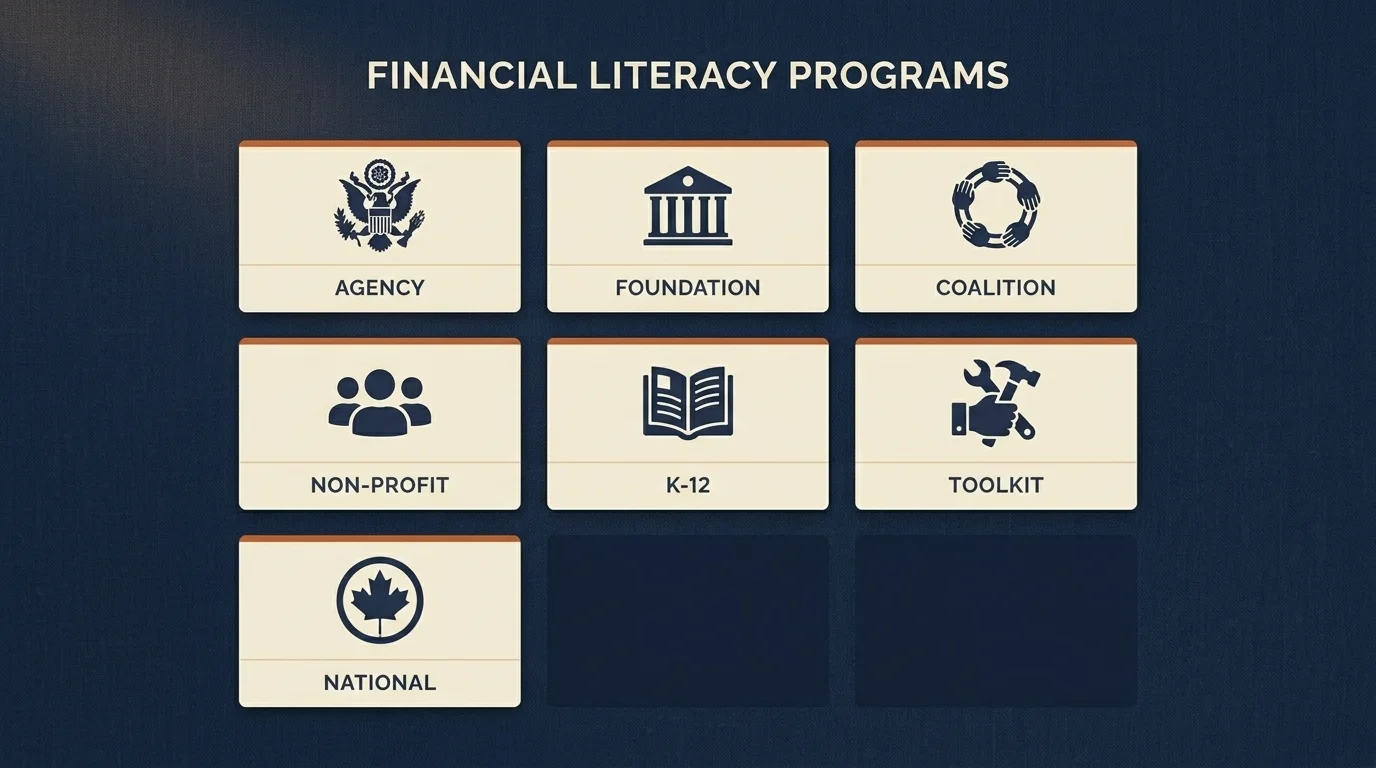
FDIC Money Smart remains the workhorse of US financial literacy campaigns. The flagship 2026 event — "Money Smart Moves: Banker Led Strategies for Financial Education and Well Being" — runs on April 22, 2026. The substantive shift here is that community banks running the curriculum on Instagram Reels have reported engagement uplifts of up to 200% over the traditional PDF-and-pamphlet activation. Money Smart is free, granular, and rated for adults, families, older adults, and small business owners.
CFPB Money Smart for Older Adults is the variant most relevant to the audience I personally see. It pairs traditional budgeting/saving content with scam-awareness material — a deliberate response to the fraud-victimisation rates that increase sharply after age 60.
ABA Foundation Financial Literacy Month runs every April and aggregates the bank-sector literacy programming, much of it now delivered via member-bank social channels.
Jump$tart Coalition's Reality Check is the K-12 piece — most relevant for parents, teachers, and credit unions running youth programs.
Operation HOPE 1MBB ("One Million Black Businesses") is the longest-running US financial empowerment campaign with explicit equity framing and has been deeply integrated into corporate financial-literacy CSR over the past two years.
Citizens Bank committed $2.85 million in 2026 to 135 local non-profit financial-empowerment programs — one of the larger named corporate commitments and a representative example of how bank capital is now backing community-level activation.
Social Assurance's 2026 toolkit has standardised the social-first content stack for community banks and credit unions — ready-made social graphics and captions on emergency funds, fair lending, and budgeting. It is the clearest evidence that financial-literacy campaigns are now structurally social-first, not just social-augmented.
For Canadian readers, FCAC Financial Literacy Month plays the equivalent role to ABA Foundation's US programming.
Related Article: Ethical Considerations in Personal Finance and Healthcare Nexus
How to vet a finfluencer in sixty seconds
This is the section the SERP does not currently have, and the one that does the most work in practice. The next time a creator gives you specific advice you are tempted to act on, run this checklist before you do anything.
1. Credentials. Are they a licensed broker, a CFP, a CFA, a CPA, or an Enrolled Agent? Run their name through FINRA BrokerCheck and the SEC IAPD database — both are free public lookups. If the creator has no licensing record and is recommending specific securities, the recommendation is not coming from someone the regulator has signed off on.
2. Disclosure. Federal law — specifically SEC Section 17(b) of the Securities Act — requires anyone receiving paid compensation to promote a security to disclose the relationship. If a creator is endorsing a brokerage app, a crypto token, or any specific financial product without an obvious disclosure ("#ad", "paid partnership", an explicit affiliate disclosure), the post is operating outside the rules the regulators enforce against.
3. Conflict of interest. Even with disclosure, ask the further question: where is this person making their money? A creator selling a high-ticket course on a topic is in a different position from one earning ad revenue on YouTube from a broad finance channel. Neither is disqualifying. But the conflict shapes what they will and will not say.
4. Claim verification. Is the specific claim (a fund-return number, a tax-loophole headline, a "free" home-equity pitch) backed by a primary source the creator links to, or is it a personal-experience anecdote? Anecdotes are not data. Real claims should be checkable — a fund prospectus, a government data source, a peer-reviewed study, a regulator filing.
5. Action vs. awareness. Apply the rule from the paradox: if the creator is teaching you that a concept exists, you can probably trust it as a starting point. If the creator is telling you to do a specific thing with your money, route that decision through a credentialed advisor before you act.
6. Regulatory shadow. Has the creator or the firms they promote been subject to enforcement action? The 2024 fines against M1 Finance ($850k) and TradeZero America ($250k) for inadequate influencer-content oversight are now the template that broker compliance teams cite when training staff. If a creator's affiliated platform shows up in enforcement databases, take that signal seriously.
Sixty seconds. The same six checks every time. They will not protect you from everything, but they will catch the worst of what the FINRA Foundation 2026 study flagged when it found that finfluencer followers were significantly more likely to be investment-fraud victims than non-followers.
Who to follow by topic
Awareness-level financial content can be useful if you follow the right creators for the right topics. Five names worth knowing, with their actual specialisations.
| Creator | Topic specialisation | Why they earn awareness-level trust |
|---|---|---|
| Tori Dunlap (Her First $100K) | Gender wealth gap, salary negotiation, women's investing | Built around named negotiation methodology and explicit advocacy framing |
| Vivian Tu (Your Rich BFF) | Personal finance basics, employee benefits, taxes | Former Wall Street trader; explains the system, not specific securities |
| Humphrey Yang | Investing explainers, index funds, market mechanics | Background in financial advising; focuses on concepts over picks |
| Erika Kullberg | Contracts, consumer rights, fine print | Attorney; reads the contract so you do not have to |
| Mark Tilbury | Wealth-building principles, business fundamentals | Long-form operator's lens on personal finance |
Use this list for awareness — what topics exist, how to think about them, where to start. Use a planner for action. The distinction is the same one the paradox at the top of this article is built on.
A note on the broader best financial influencers universe and TikTok financial advice more generally: the platform is not the variable. What matters is whether the creator is operating in awareness mode (here is how a Roth IRA works) or action mode (buy this token by Friday). The 71% misleading-content rate applies to the action-mode content, not the awareness-mode content. Treat the platform as a starting point, not a destination.
Gamified financial literacy apps compared
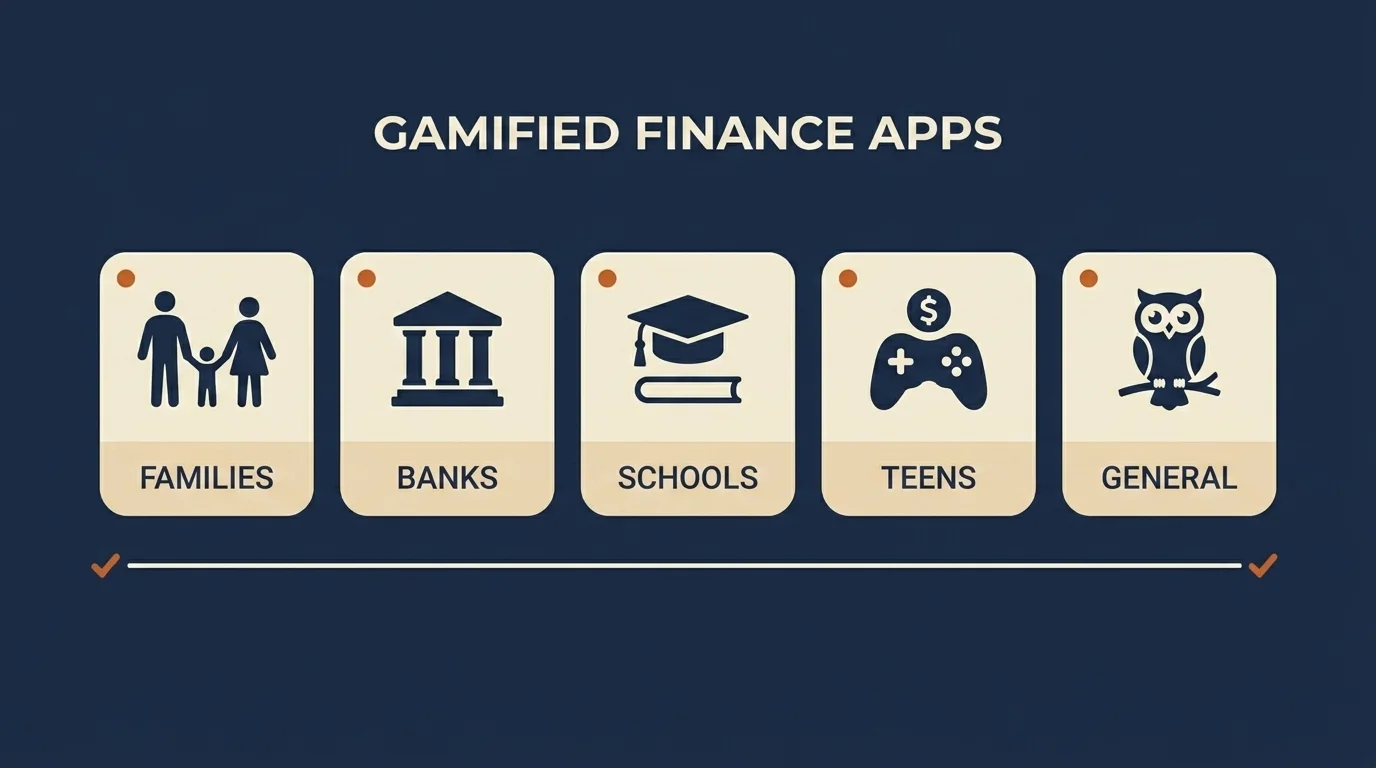
The category is growing fast. The gamified financial literacy app market sat at USD $982.4 million in 2024 and is projected to reach USD $4.22 billion by 2032 (~19.8% CAGR). A short list of the named players.
| App | Audience | Approach | Distribution |
|---|---|---|---|
| Greenlight | Families with kids/teens | Debit card + parent-controlled app with bite-sized money lessons | 6M+ users; $550M VC raised |
| Zogo | Adults via financial institutions | Modular gamified literacy tied to a bank or credit union account | Deployed at 250+ FIs including Chime, Sezzle, New York Life |
| Goalsetter | K-12 + families | Quizzes + goal-based savings | Community partnerships, school deployments |
| Step / Copper | Teens / young adults | Banking app with embedded financial lessons | Direct-to-consumer |
| Duolingo finance modules | General audience | Familiar Duolingo loop applied to finance basics | Part of broader Duolingo product |
The honest read on this category: gamified apps are good at the awareness layer and good at building habits. They will not replace a planner for the action layer, and a 30-minute Greenlight session will not tell you whether to do a Roth conversion this year. But for the basic literacy that 67% of Gen Z says has improved their finances, they are doing real work.
What 2026 regulators are doing
The regulatory shadow over finfluencer content has hardened sharply since 2024, and it is worth tracking if you spend time on this side of the internet.
In February 2026, UK courts sentenced seven social-media influencers for promoting unauthorised foreign-exchange trading to a combined 4.5 million Instagram followers. The same source reports that the SEC brought charges against crypto trading platforms for social-media fraud totalling $14 million in early 2026.
In May 2026, NASAA — the North American Securities Administrators Association, representing state-level securities regulators — submitted a formal comment letter on FINRA's Social-Media-Influenced Investing Report. State regulators signalling that they want a tighter framework matters for the same reason state-level enforcement always matters: it adds a layer of accountability the federal level alone cannot.
The FINRA Foundation's 2026 study "Finfluencer Followers and Social Media Scrollers" produced the headline finding that drives the whole framework: followers of finfluencers were significantly more likely to be victims of investment fraud than non-followers. That is not a moral judgment on creators or audiences. It is a measured signal that the channel and the harm are statistically associated, and it is the empirical case for the vetting checklist above.
No new finfluencer-specific federal legislation has passed. The primary statutes regulators are using are the same ones that have always covered this — SEC Section 17(b) anti-touting, Rule 10b-5 anti-fraud, and the Investment Advisers Act. The novelty is enforcement velocity, not new rules.
A closing word from a planner
If you take three things from this article, take these.
First, use financial-literacy social media for awareness — the 67% of Gen Z who say it improved their finances are getting real value. Almost any reasonable explanation of how compound interest, taxes, or asset allocation work is a net positive over not knowing.
Second, route every action through a credentialed source. The 37% who got into financial trouble after acting on creator advice did not need better creators. They needed a vetting checklist and a planner. The six-question checklist in this article takes about a minute to run, and it would catch most of the harm in that statistic.
Third, treat the named campaigns and government resources as the durable layer. FDIC Money Smart, CFPB, ABA Foundation, Jump$tart, Operation HOPE, MyMoney.gov, FCAC — these are not trying to sell you anything, they update annually, and they tend to be substantially more accurate than the median creator video. Bookmark one of them.
The right answer for your specific situation depends on facts I cannot see from a blog post — your time horizon, your marginal tax bracket, your account types, your household balance sheet. Treat this as the start of the conversation with a fiduciary advisor, not the end of one. Awareness is the channel. Planning is the work.
Frequently Asked Questions
The 2026 campaign roster runs across government, non-profit, and bank-backed programs: FDIC Money Smart (with the April 22, 2026 'Money Smart Moves' flagship event), CFPB Money Smart for Older Adults, the ABA Foundation's April Financial Literacy Month, Jump$tart Coalition's Reality Check for K-12, and Operation HOPE's 1MBB initiative. Corporate examples include Citizens Bank's $2.85M 2026 grant commitment to 135 local non-profit programs, and Social Assurance's 2026 social-first toolkit standardising activation for community banks and credit unions.
Run six checks in about a minute: (1) credentials — look up the creator on FINRA BrokerCheck and the SEC's IAPD database; (2) disclosure — SEC Section 17(b) requires paid promotions of securities to be disclosed; (3) conflict of interest — note where their actual income is coming from; (4) claim verification — is the specific claim linked to a primary source or just personal experience; (5) action vs. awareness — accept their content as education, route any actual financial decision through a credentialed advisor; (6) regulatory shadow — check whether the creator or their affiliated platforms have been subject to enforcement action.
Greenlight (6M+ users, family/kid banking with embedded lessons), Zogo (deployed at 250+ banks and credit unions including Chime, Sezzle, and New York Life), Goalsetter (K-12 plus families), Step and Copper (teens and young adults), and Duolingo's finance modules. The category is real — the gamified financial literacy app market for Gen Z sat at $982.4 million in 2024 and is projected to reach $4.22 billion by 2032. They are strong for the awareness layer; they will not replace a planner for specific decisions.
Use it for awareness, not action. An analysis of 2,470+ stock-related videos targeted at young adults found that 71% contained misleading financial advice, and 37% of Gen Z viewers report getting into financial trouble after acting on creator advice. The same survey found that 67% say online learning improved their financial situation — the difference is whether they were taking the content as education or as a buy signal. Verify any actionable advice with a regulated source or a credentialed advisor before acting.
April. In 2026, the FDIC's flagship 'Money Smart Moves' event is on Wednesday, April 22. MyMoney.gov, the ABA Foundation, Jump$tart Coalition, Operation HOPE, and most US community banks and credit unions publish free workshops, social toolkits, and downloadable curricula during the month. Canadian readers should look at FCAC Financial Literacy Month for equivalent national programming.
A finfluencer is a social-media creator producing financial content — often around investing, personal finance, or specific products. They are regulated under existing securities law, primarily SEC Section 17(b) (anti-touting / paid-promotion disclosure), Rule 10b-5 (anti-fraud), and the Investment Advisers Act. Enforcement velocity has hardened sharply since 2024: FINRA fined M1 Finance $850k and TradeZero America $250k for inadequate influencer-content oversight, and the SEC has brought social-media fraud charges totalling $14 million in early 2026. There is no new finfluencer-specific federal law — the existing statutes are being applied.