
Finance ai


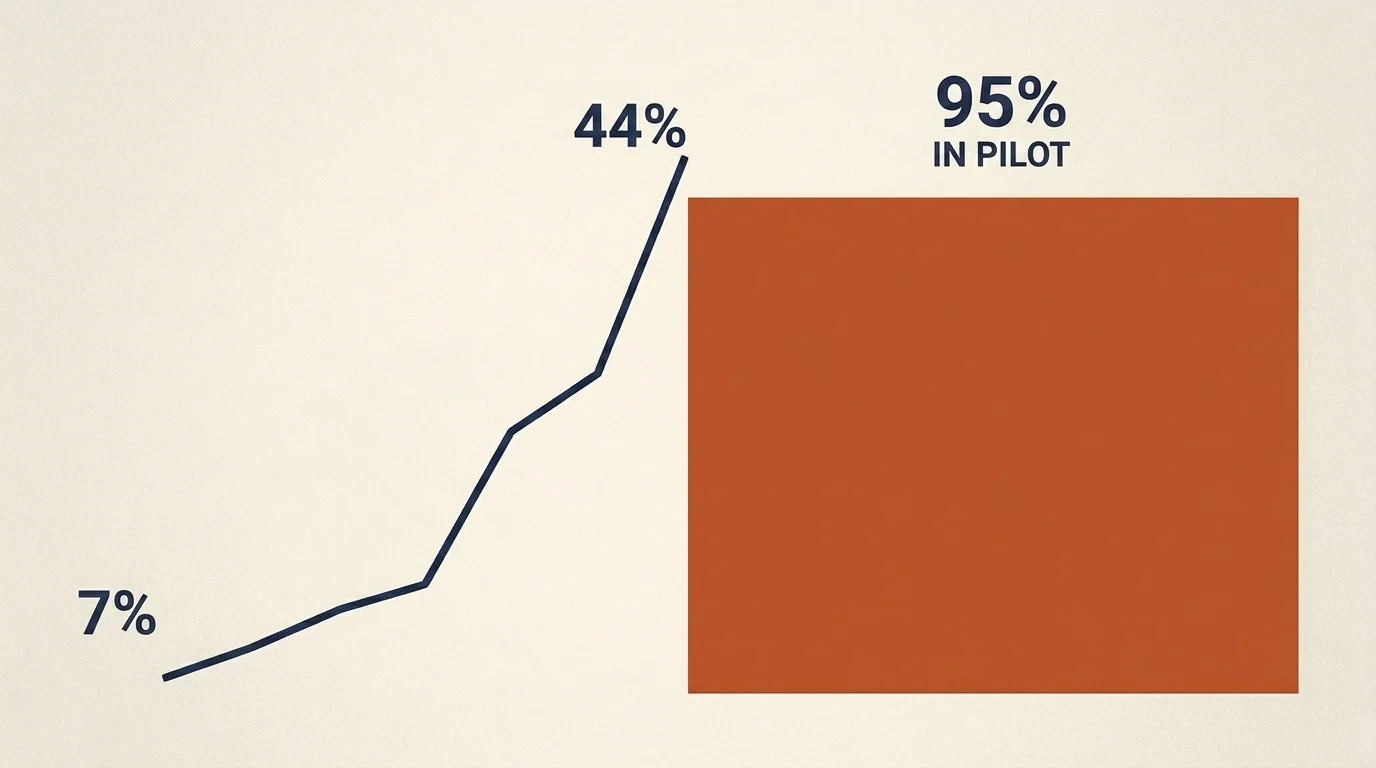
At Fidelity, an artificial-intelligence system called Freya now reviews a customer's entire portfolio, monitors their goals, and executes trades on their behalf — once the customer signs off. A decade ago that sentence would have described a human adviser and a spreadsheet. This is finance AI in 2026: software, mostly machine learning, that reads financial data to lend, invest, forecast, and catch fraud faster than any person can, and increasingly acts on what it finds rather than just reporting it. And the pace is not gradual. Fewer than 7% of finance teams had deployed agentic AI in January 2025; by the first quarter of 2026 that figure had reached 44%.
Finance has absorbed every prior wave of computation — the electronic quote, algorithmic execution, the first robo-advisors — and called each one a revolution in its moment. I'd argue AI is the current chapter of that long story rather than a rupture in it, and that matters, because it tells you how to read the claims. What follows is an attempt to say plainly what this technology genuinely does, what it still cannot, and what the shift means for your own money and your own job. And to keep asking the question the vendor pages skip: as intelligence moves into finance, who does it actually serve, and who bears the cost?
What is AI in finance?
AI in finance is software — mainly machine learning — that analyzes financial data to invest, lend, forecast, and detect fraud faster and at greater scale than people can.
Underneath that one sentence sit three layers worth separating, because they are routinely blurred. Machine learning is pattern-finding on past data: it learns what fraud looked like before and flags what resembles it now. Generative AI drafts — a market commentary, a risk summary, a first pass at analysis — in language a person then checks. Agentic AI, the 2026 arrival, is the one that changes the register: systems that do not merely answer but decide and act, executing a workflow end to end rather than handing you an output to approve line by line.
You will see this same thing called finance AI, AI in finance, AI for finance, and artificial intelligence in finance. They are the same subject wearing different phrasings, and I use them interchangeably below. The distinction that actually matters is not the label — it is the one between a system that can draft and a system that can act, because that is where the money, and the risk, begins to move.
The 2026 reality: agentic AI jumped from 7% to 44% — yet 95% is still a pilot
Here is the fact the industry press leads with, and it is real: agentic AI in finance went from fewer than 7% of teams in January 2025 to 44% by the first quarter of 2026 — close to a 600% jump in a single year — with global agentic-AI spending in financial services projected at $50 billion by the end of 2026. Narrow the lens to generative AI in financial services specifically and the projected curve is steeper still — from $1.89 billion in 2025 to $2.48 billion in 2026, and $7.24 billion by 2030.
A McKinsey survey of finance leaders happens to trace the same 7-to-44 arc — 44% of CFOs using generative AI across five or more use cases in 2025, up from 7% the year before, with 65% of organizations planning to increase investment. Those matching digits are a coincidence, not corroboration: McKinsey is counting how widely CFOs use generative AI, not how many teams have deployed agents. Different technology, different population, different years. Two instruments measuring two things — and pointing the same way. The direction of travel is not in doubt.
Here is the fact the same press tends to bury: roughly 95% of generative-AI implementations in financial services are still in pilot, not scaled production. Both numbers are true at once, and holding them together is the whole discipline of reading this moment honestly.
I spent years distinguishing funds that called themselves sustainable from funds that could demonstrate they had changed anything, and the instinct transfers cleanly here. Fast adoption is a claim about intent and spend. It is not yet evidence of results at scale. When a vendor tells you AI agents "break this boundary" and "bring autonomous reasoning to financial workflows" — a real and fair description of the technology's ambition — the right response is not disbelief and not applause. It is a question: deployed where, at what scale, and what would count as this having failed? The 95%-pilot figure is the market quietly answering that most of it does not yet know.
How is AI actually used in finance?
AI in finance powers fraud detection, algorithmic trading, risk management, forecasting, customer chatbots, and personalization — and it is most mature, by a wide margin, in fraud detection.
Fraud detection
This is the use case that has genuinely graduated from pilot to plumbing. Around 90% of banks now use AI for fraud detection; of the institutions using it, roughly 72% report about 40% fewer fraud losses and around 50% fewer false positives, and JPMorgan reports 98% detection accuracy against the 85–90% of older rule-based systems. The market has followed the results: AI fraud management alone is sized at $15.53 billion in 2025, rising toward $18.48 billion in 2026. The reason fraud leads is instructive: it is a narrow, high-volume problem with a clear right answer and constant feedback, which is exactly the shape of task machine learning is good at. It is also the honest benchmark for everything else — when a vendor claims a use case is "production-ready," the fair question is whether it is as proven as fraud detection, and usually it is not.
Algorithmic trading and markets
Pattern-driven execution and signal detection at machine speed is the oldest form of AI in markets, predating the current wave by years. It is powerful and it is unglamorous, and it is worth remembering that "the machine trades faster than you" has been true, in some form, since well before 2026. I'd add the caveat the marketing rarely does: speed cuts both ways. The same automation that finds an edge in milliseconds can amplify a sell-off just as fast, which I'd read as a large part of why exchanges have circuit breakers at all. The tool that makes a market more efficient in calm conditions is not automatically the one you want unsupervised in a panic.
Risk management and forecasting
This is where generative AI is doing its most concrete corporate work right now. McKinsey's account of finance teams describes the tasks plainly: drafting commentary, writing performance summaries, and running scenario models — first drafts and analysis a person still signs off on, not decisions made unattended.
Customer service and personalization
Chatbots and tailored guidance are the consumer-facing edge, and the 2026 version is more than a scripted FAQ. Salient, for one, runs end-to-end loan servicing for the auto lenders Westlake Financial, American Credit Acceptance, and Exeter Finance — an agent handling a whole workflow, not answering a single question. That is the direction: from answering to acting.
What AI in finance gets right — the real benefits
Where the task is narrow and measurable, the benefits are not marketing. Speed and round-the-clock operation are the obvious ones — a fraud model does not sleep, and anomaly detection across millions of transactions is simply not something a human team can do at that scale. The cost case is real too: automating routine middle- and back-office cognitive work is credited with 30–60% cost savings in the specific function areas it targets. At the top end, JPMorgan reports more than 2,000 AI specialists, 400-plus use cases, and roughly $1.5 billion in cumulative savings.
The market is voting with capital: AI in finance is sized at $17.7 billion in 2025, rising to about $21.2 billion in 2026, near a 19.5% annual growth rate. I'd read that momentum as a proxy for real traction, not proof of it — money chases both winners and hype. The honest version of this section is narrow: the benefits are demonstrable where the job is specific, high-volume, and easy to check. Keep that qualifier attached, because the next section is what happens when it comes off.
What AI in finance still can't (or shouldn't) do
Start with the immaturity already noted: 95% still in pilot means most of what you are being sold is unproven at your scale, and a buyer's — or a reader's — skepticism is not cynicism, it is diligence.
Then the older problems, which AI inherits rather than solves. A model learns from past data, so it also learns the bias in that data; a lending algorithm trained on decades of who got approved can quietly reproduce who got excluded, and finance's history of redlining and structural exclusion is not a settled matter it has moved past. Data privacy sits alongside it: financial data is among the most sensitive there is, and pointing more automated systems at it enlarges the surface that can leak or be misused.
There is a subtler cost that I think gets too little attention. As agents take over more of the analytical and operational work, there is a genuine risk that human finance professionals lose the skills and judgment needed to catch the model when it is confidently wrong. The whole case for automation assumes a competent human in the loop for the hard calls — and the automation itself can erode the very competence it depends on. Oversight is not a compliance checkbox here. It is the thing that decides who bears the cost when an automated decision goes wrong, and right now that cost lands, disproportionately, on the person the decision was made about.
AI for your own money
Most coverage of this topic stops at the enterprise, because that is who buys the software. But the more consequential shift for most readers is that these tools are moving from institutions into personal money management — the same democratization arc that took stock trading from a broker's phone to an app on yours. Before going further: what follows is explanation, not individual financial advice, and for your own circumstances there is no substitute for a licensed advisor.
Robo-advisors vs. human advisors
An AI advisor like Fidelity's Freya can research, monitor a portfolio continuously, and execute trades once you approve them. That is genuinely useful, and for straightforward, low-cost portfolio management it does much of what a human once charged a fee to do. What it does not do is the messy part: weighing a career change against a mortgage, talking you out of panic-selling in a crash, or understanding that your goals are not fully captured by a risk-tolerance slider. The relationship, the judgment, and the awkward human questions are where a good human advisor still earns their keep. The useful frame is not robo or human but which layer of the problem you are actually trying to solve — and that starts with knowing which investment strategies actually fit you before you hand any of it to a machine.
Everyday AI money apps
Below the advisory tier are the everyday tools — budgeting and coaching apps such as Cleo that nudge, categorize, and answer money questions in plain language.

These apps are helpful for building awareness and habit, and they are not fiduciaries. My read is that they optimize for engagement at least as much as for your net worth, and the free ones are free for a reason worth understanding before you follow their prompts.
The tools people actually use (and their limits)
Let me say the unhelpful-sounding thing plainly: there is no single "best AI for finance," and any article that names one is usually selling it. The right tool is a function of the job, so it is more honest to think in categories than in rankings.
For institutions there are enterprise analytics and audit tools built for fraud, reconciliation, and reporting. For individuals there are consumer budgeting apps and robo-advisors. And across both sit the general assistants — ChatGPT and its peers, the thing people mean when they search "finance ChatGPT" — genuinely useful for research, explanation, and drafting, provided you treat every output as a draft to verify rather than an answer to trust.
That last point is the one a vendor will not put in its own marketing, so an independent site should: these tools hallucinate, they carry no fiduciary duty to you, and confident phrasing is not the same as being right. Verify anything that touches a real decision. The limits are not a footnote to the tool; they are part of it.
What it means for finance jobs — and the rest of us
The 30–60% cost savings that make AI attractive are, read from the other side, jobs — and they fall hardest on the transactional and analytical roles that were the traditional first rung into finance. The optimistic framing is that people are repositioned toward oversight and judgment, and some genuinely are. The framing that gets less airtime is that "repositioned" does uneven work in a sentence, and that the rung being automated is often the one newcomers used to climb.
There is a real upside worth naming with the same honesty. Advice that once required enough wealth to interest a human advisor can, if the tools are trustworthy, reach people who were priced out of it entirely — a genuine widening of access, and part of how a person of ordinary means starts building generational wealth rather than merely surviving month to month. But if trustworthy is carrying the whole sentence. Cheap advice that is biased, or that quietly serves the platform before the user, does not democratize anything; it just distributes the downside more widely.
This is the part I keep returning to, and it is the part the vendor pages leave out. Every prior wave of financial technology displaced some roles and created others, and each was narrated at the time as pure progress. The question worth carrying out of 2026 is not whether AI in finance is coming — it is here — but the older one underneath it: who benefits from this arrangement, and who bears the cost?
The verdict
Finance AI in 2026 is real and fast-moving where the task is narrow and checkable, still mostly unproven at scale, and most consequential not in the technology itself but in what it means for your money, your job, and who finance ends up serving. Hold both halves of that at once and you will read the coming year more clearly than most of the coverage will.
So of any claim you meet — a tool, a headline, a "revolution" — ask what I ask of any financial arrangement: who benefits, and who bears the cost? Treat the revolution label as a claim to verify, not as evidence in itself. Keep learning how these tools fit your actual goals, and before you act on your own money, consult a licensed advisor.
Frequently Asked Questions
There is no single winner — it depends on the job. Institutions use fraud and analytics tools; for personal money, budgeting apps (such as Cleo) and robo-advisors are more relevant. Match the tool to the task, not to a ranking.
Not fully. AI advisors like Fidelity's Freya handle research, monitoring, and trade execution with your sign-off, while human advisors still do the judgment, oversight, and relationship work a risk slider cannot capture.
Algorithmic bias, data privacy, over-reliance and skills atrophy, and immaturity — roughly 95% of generative-AI implementations in financial services are still in pilot rather than scaled production. Human oversight remains essential.
Yes. General assistants like ChatGPT and the free tiers of budgeting apps can help with research and tracking, but they are not licensed advisors and can be confidently wrong — verify every output before you act on it.
Yes — institutes and universities offer AI-in-finance courses. But the field moves quickly, so applied skills and good judgment matter more than any single badge.